Cracking the information frontier
The information frontier grows faster than today's data access protocols, yet the most valuable computations rely on exactly that frontier data. We are building the data multiplexer, a technology that anyone can point at the information frontier to discover, access, route and manage data flow for their most valuable computations. The reference user study below spanning usage from May to August 2026 illustrates the gains and scale of our technology over existing data procurement protocols.
There is an edge to what any system can know. Everything that has been sensed and digitized at a given point in time sits inside what we call the information plane. Everything beyond it, the API not yet connected, the dataset not yet indexed, is the information frontier. Two properties of that frontier drive everything we build. 1) It never closes, because the physics of storage and energy puts full digitization of the world permanently out of reach, so new data keeps appearing at a rate higher than systems can process it. 2) And it is where the value sits, because the data commanding the highest premium, by economic construction, is exactly the data not everyone already has.
In our first "frontier probe" [1] in May 2026 we pointed frontier models at 125 sources across five verticals and five access gates, 1,123 attempts in total. On open-web sources the models got the data 80% of the time while combinations of access complications (auth, email signup, payment, among others) quickly deteriorate data access even for the most capable frontier models. The throughline is that access obstacles, not model capabilities, starve the most competent systems from realizing their ROI on economically valuable tasks. Computation has entered a super-acceleration and super-adoption era: LLM-based technology is pumped into every corner of the economy. Our core thesis put in a few sentences is this: to realize return on investment these computations have to be able to run on the economically valuable tasks. To the largest extent, such tasks rely on information from the frontier, i.e. information that is not widely disseminated, yet. Today's protocols for shoveling data from the frontier into computations primarily run on arcane rails, human processes and static broker catalogues that were not built for the fast, adaptive compute of the LLM super-adoption era. The bottom line is that technology shovels, not human shovels, are needed to bring frontier data access velocity up to today's computation needs.
That is what we are building Brickroad for: a data multiplexer that anyone can point at the frontier to discover sources, get evidence-backed qualification, automated data provisioning and deal tracking, while your team elevates to system operator at scale. Below we trace the gains through a reference user study of one production deployment, May through August 2026.
>200× frontier throughput
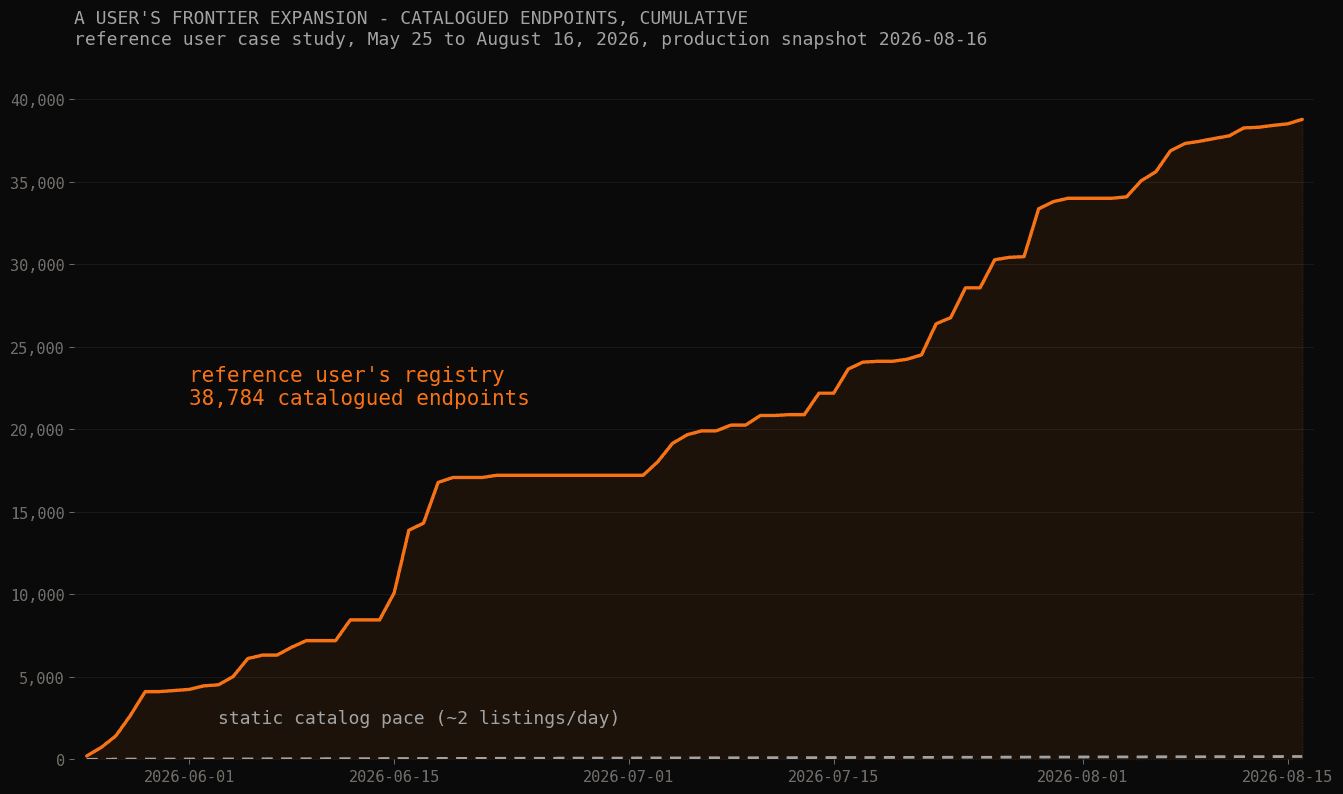
Static catalogs grow at human speed: Neudata [2] lists 4,200+ providers gathered since 2016, Snowflake Marketplace [3] 3,400+ listings since 2019, Datarade [4] 2,600+ since 2018, AWS Data Exchange [5] 3,500+ since 2019. One to two listings per day, for years. Since it opened on May 25, the reference user's registry grew by 38,784 endpoints across 17,033 providers, a median of 425 per active day, and the reference agent alone discovered a median of 412 candidate sources per active day with a one-day peak near 4,000. The chart at the top of the post shows the registry's cumulative curve. The rate is set by demand, not capacity, because adding an agent takes minutes while the static side adds people. 425 a day against 2 a day is more than 200 times the pace. In contrast, 88.7% of the sources delivered to the user across our production system are net new and not present in the 14 catalogs we index. Static and slowly evolving broker catalogues are not ready to keep pace with the frontier.
>50× productivity gains
A request works like this: the client nodes register their data need, and a table of source and contact rows comes back, each claim carrying an evidence record from pages fetched during that request. During the reference user study the deployment completed 83 requests, at a median of 50 minutes from submission to delivery. 83% of submissions completed, 95% of completions finished within 4.5 hours, and the median table held 8 rows against a mean of 12.7.
Producing one of those rows by hand takes 20 to 40 minutes of a person's time. Transposing this onto market rates for existing procurement protocols ranges from $54 to $109 [6] [7] for a loaded US analyst hour, posted salary bands for this role at US investment firms loading to $58 to $88 per hour [8] [9] [10], a quant researcher about $195 [11] [12], or consultants billing $100 to $350 [13]. A hand-researched row therefore costs $18 to $233 and lands the next business day. The multiplexer produces the same row for $0.368 in model spend, arriving within the hour, and enabling the analyst to operate across more leads in parallel in shorter time.
<60s to live data sample
The next step in the client's waterfall entails drilling down into individual endpoints of interest and pointing the data multiplexer to provision access. In this case, 86 of the 116 (74%) endpoints of interest returned a verified live sample: at least 3 real records, and an exact echo of the fetched URL. Median time from drill-down to sample in hand was 38 seconds.
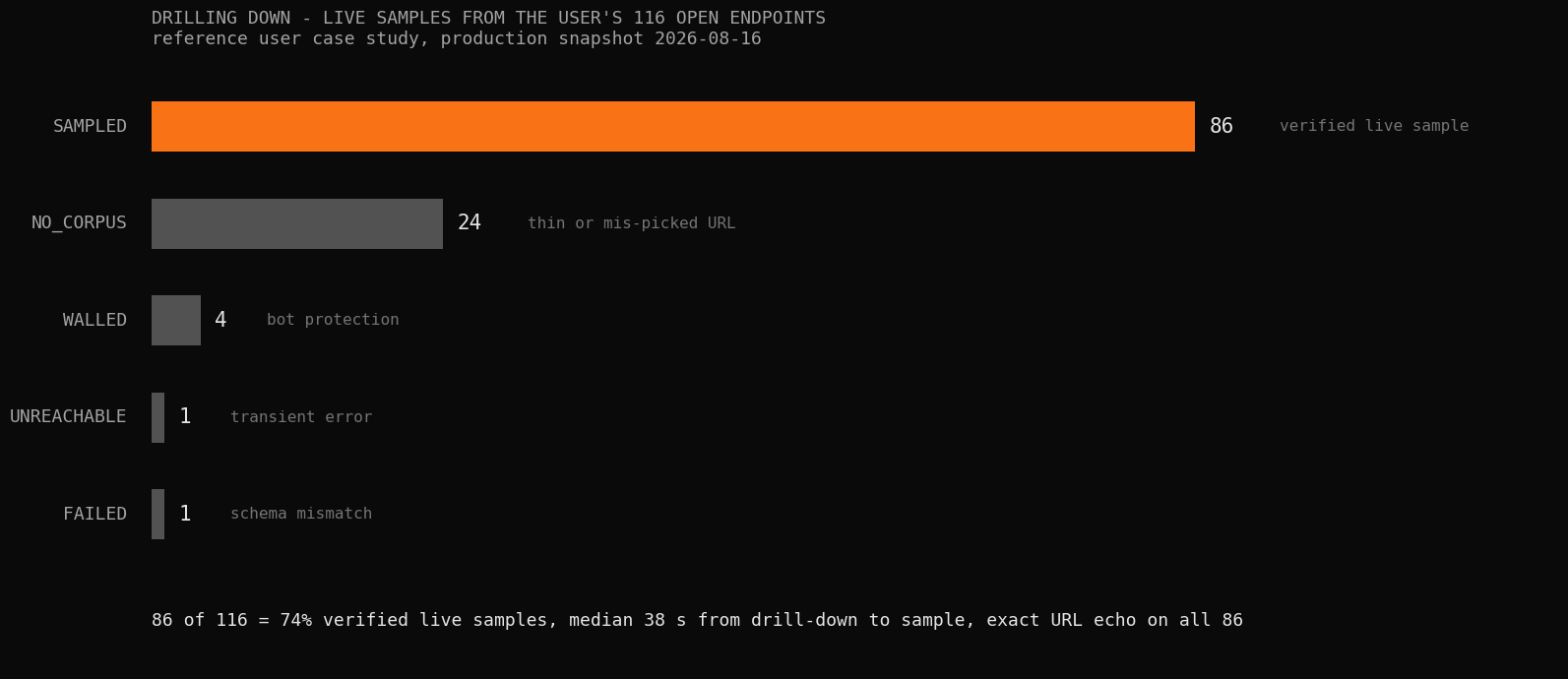
The vendor route to the same first sample is an email inquiry, and a trial that Neudata [14] pegs at about 3 months and Eagle Alpha [15] says should run at least 3. Even a vendor that answers within a single day is more than 2,000 times slower.
Where this goes
The multiplexer already runs discovery, qualification, and endpoint sampling on technology rails. We are extending the same rails through the gated tiers: automated outreach and deal tracking for sources that need a conversation, credentialed access for keyed and subscription APIs, and routing so that data flows from any source straight into the computations that need it.
The vision is data access at the speed of compute. Computation is being pushed into every corner of the economy, and its returns depend on reaching the information frontier as fast as it expands. We are building the multiplexer so that any user can point it at the frontier and operate data flow at system scale instead of static catalogue pace.
References
- "The information frontier", X, May 2026
- Neudata
- Snowflake Marketplace
- Datarade
- AWS Data Exchange
- US Bureau of Labor Statistics, Occupational Employment and Wage Statistics, May 2025, financial and investment analysts
- US Bureau of Labor Statistics, Employer Costs for Employee Compensation, March 2026
- Posted salary range, data strategist role, New York
- Posted salary range, data sourcing and strategy analyst role, New York
- Posted salary range, data sourcing specialist role, New York
- Selby Jennings, quantitative analytics, research and trading salary guide, 2024
- Public H1B visa filings, quantitative researcher base salaries
- Data analytics consulting hourly rates, 2026 guide
- Neudata, turning data into revenue, 2026
- Eagle Alpha, alternative data provider guide, 2024