You Probably Shouldn't License Your Data — But If You Do, Here Are Some Things To Keep in Mind
Notes from a talk at Compound VC's Data Factories Day. Everyone is about to experiment with licensing their data. Most shouldn't. The tenth-of-a-tenth rule, the twelve-month horizon, the logo trap, the five conditions under which licensing is actually a business, and how to structure the first deal so there is a second one.
I recently had the pleasure of giving this talk to a group of biotech companies in SF at Compound VC's Data Factories Day.
Shelby Newsad on X: Freeman Lewin at Compound's Data Factories Day
The talk went well enough that I thought that there might be some lessons to impart to others just now exploring licensing their data. In particular, we've been seeing a deluge of inbound requests from companies looking to license their systems of record data as a result of the push by certain data production companies. If that's you, read on.
Generally, I think licensing data is a great idea. I run a data licensing infrastructure company, after all. I believe we are at the precipice of a new era in the economics of the internet, and those who will win for the next ten to twenty years will carve out data licensing arms as a secondary revenue stream today. But I also caution more generally. Data licensing is not an easy revenue stream for most at this stage. Technology is sorely lacking in this space, and the entire industry is made up of 1:1 human relationships. Thus, focusing on it early is often a distraction, if not a death knell. As a general rule, great companies have great data that yields long-term deals. Companies that over-index and distract themselves from building great companies in favor of data licensing today will struggle.
What follows is the argument I made in the room and have been making on X in the weeks since, with the slides reflecting my prose. It is organized the way the talk was: why everyone is suddenly asking this question "should I license my data", what is actually for sale, reasons you probably shouldn't, and the conditions under which you should, and, if you do, how to prepare so that the first deal doesn't foreclose the second.
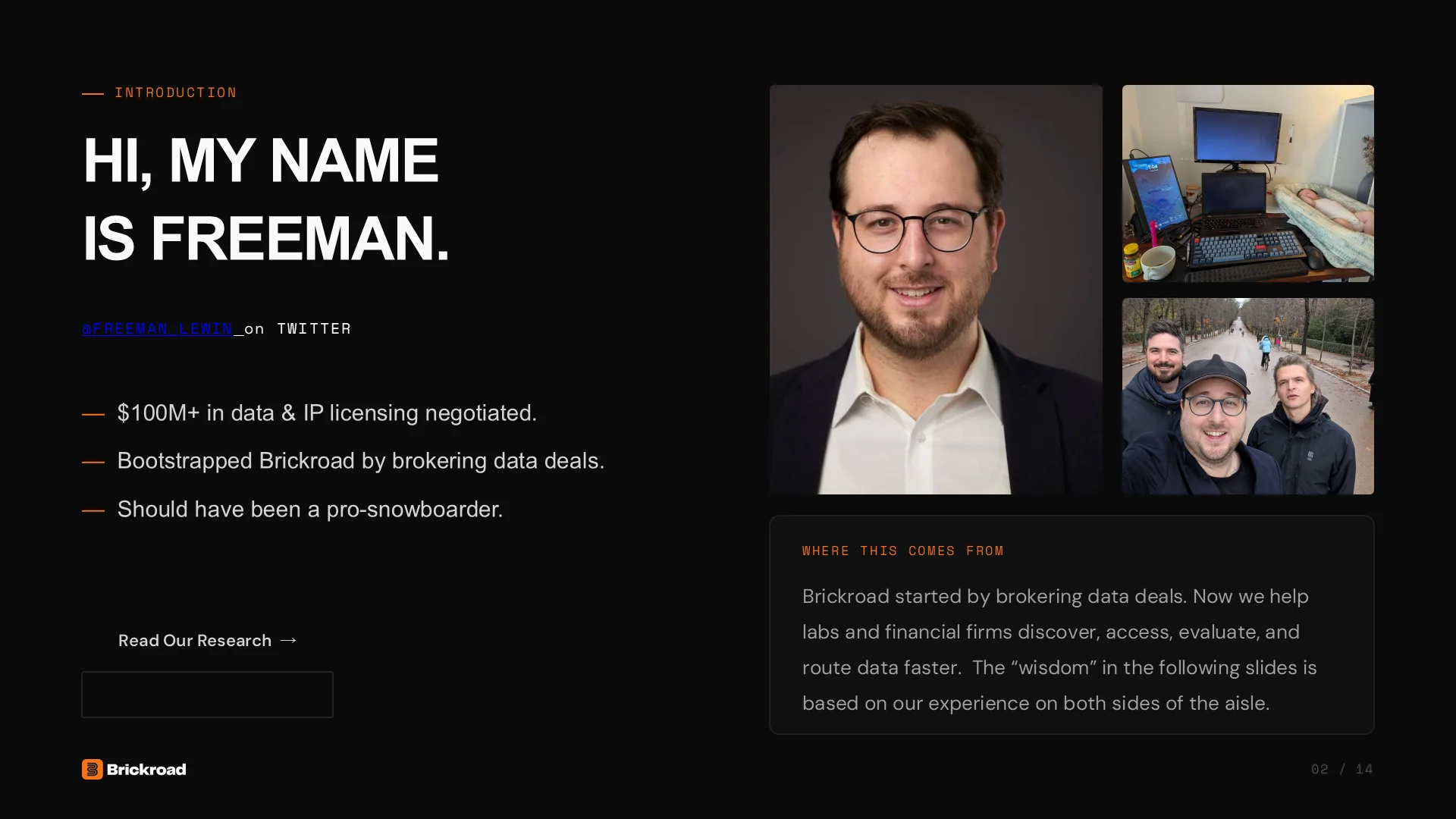
Where this comes from
A word on why you should listen to any of this. Before Brickroad was a technology company, it was a data brokerage. Between my early career in Private Equity, a stint as an M&A attorney, and the early days of Brickroad, I've negotiated north of $100M in data and IP licensing deals. Today we build the infrastructure that helps labs and financial firms discover, access, evaluate, and route data, which means we now spend most of our days on the buy side, watching and helping buyers decide which data to buy. As a result of our unique position, and in an effort to deliver a better product for our buyers — we also selectively work with certain suppliers to bring them to market.
The "wisdom" below is based on experience on both sides of the aisle, and it is colored by the fact that I have watched a lot of first-time sellers lose money, time, and moat on deals they were excited about.
Why everyone is suddenly asking
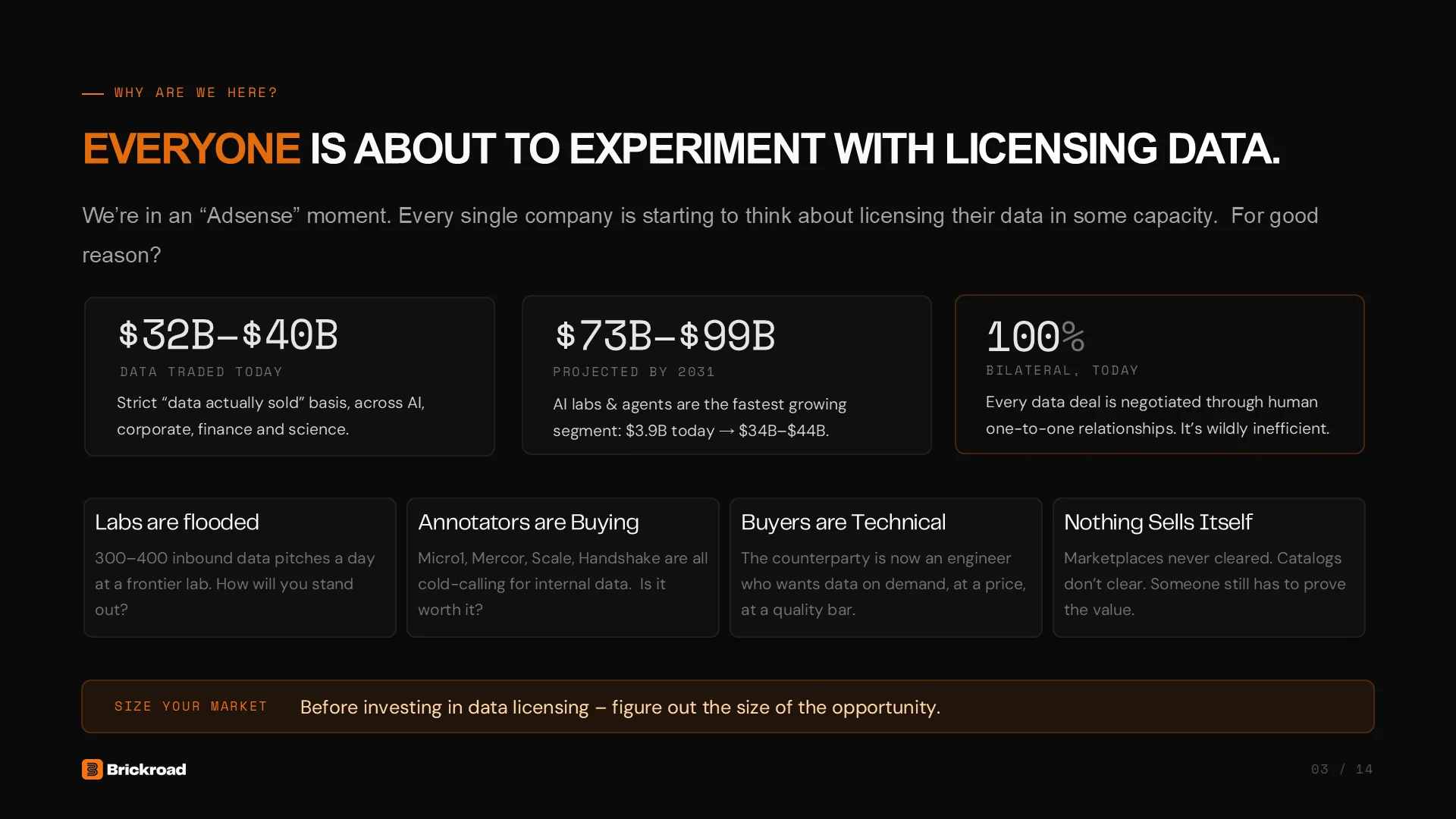
We are in an AdSense moment. Every company, in every sector, is starting to think about licensing its data in some capacity, the same way every publisher with a website in 2004 suddenly thought about running ads. And for good reason, at least on paper.
On a strict "data actually sold" basis, across AI, corporate, finance, and science, somewhere between $32B and $40B of data trades hands today. The projections put that at $73B to $99B by 2031. The fastest-growing segment, by a wide margin, is AI labs and agents: roughly $3.9B today, projected to land between $34B and $44B. And every single one of those dollars, today, is negotiated bilaterally, human to human, one relationship at a time. It is a wildly inefficient market — which is exactly why we built Brickroad.
But data markets contain multitudes, and you should hold all of them in your head before you invest a dollar:
Labs are flooded. A frontier lab receives somewhere between 300 and 400 inbound data pitches a day. Not a month. A day. Whatever you send is competing with that.
Annotators are buying. In a seemingly sudden market shift, Micro1, Mercor, Scale, Handshake, and the rest of the post-training supply chain are cold-calling companies for internal data and, increasingly, for access to their knowledge base. This new phenomenon is what prompted this post. If you have received one of those emails and wondered whether it was worth it, this post is for you.
Buyers are technical. The counterparty is no longer a business development person with a budget. It is a researcher or engineer who wants data on demand, at a transparent price. Expect that they will run an eval on your sample before anyone schedules a call — make that sample readily available.
Nothing sells itself. Marketplaces never cleared. Catalogs don't clear. Someone still has to prove the value. I wrote at length about why in The Geometry of Data Markets, and I will not repeat it here, except to say that if you believe listing your data somewhere constitutes a complete licensing strategy — you're selling yourself short. That said, you're welcome to list for free on Brickroad 😊.
So before you invest in data licensing, size the market. Not the $40B market. Yours. How many people will derive value from your data? And what will it take to stand out from the pack.
What is actually for sale
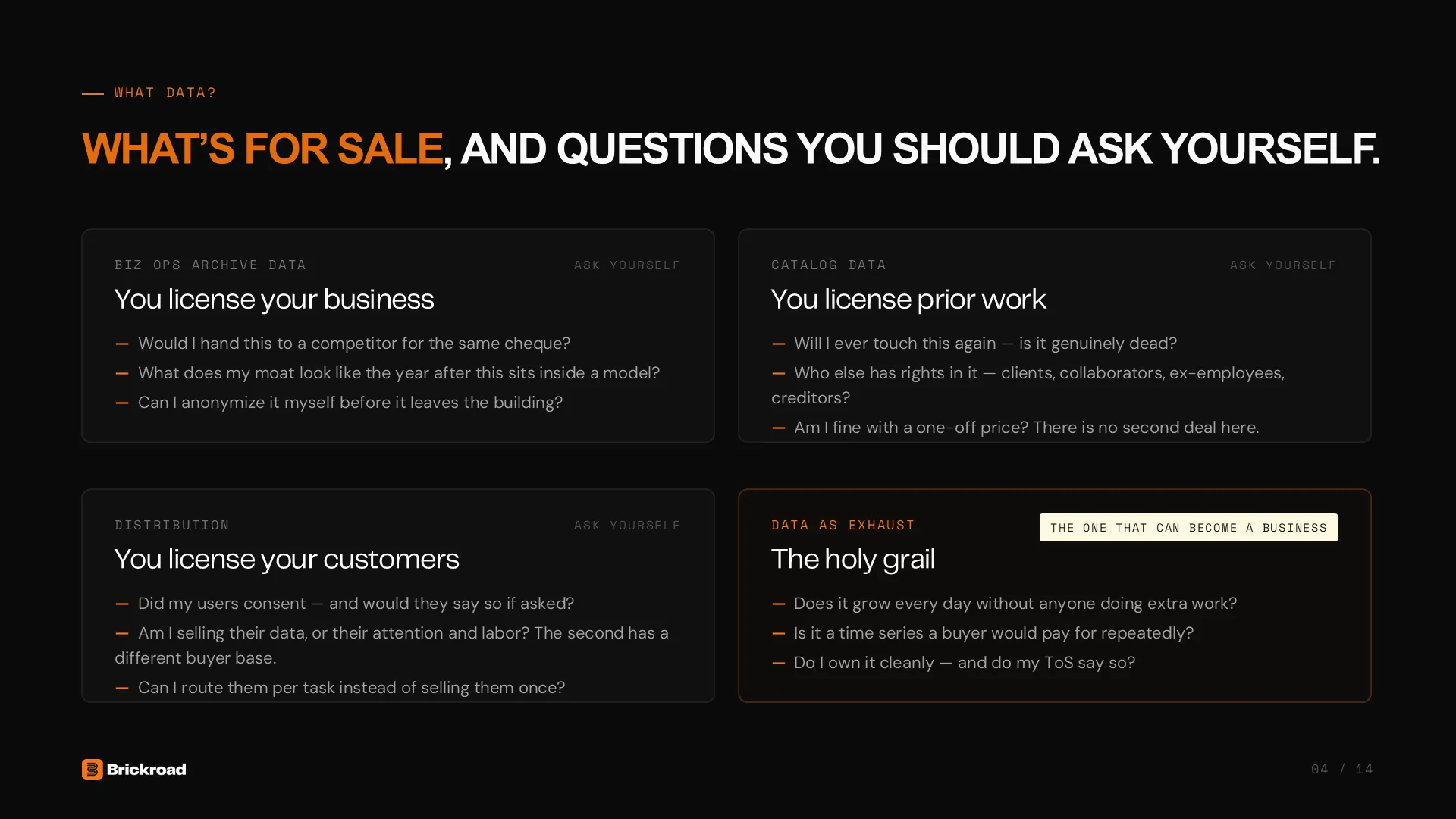
Remember about the multitudes? "Licensing your data" can mean many different things to many different people. How you go about licensing — or, more so, what you license — can determine whether you have a long term business, or a one time check.
Business operations archive
You license your business — your "system of records". The logs, the records, the transactions, the assay results, the support tickets, the things your company produced while doing whatever it does. This is what many SMBs think when they think of "licensing our data" — wrongly, but it's what the brokers are most after at the moment.
When considering this path, ask yourself: Would I sell my company to a competitor for the same check? Because once it sits inside a model, that is approximately what you have done. What does my moat look like the year after this is trained on? And can I anonymize it myself, in-house, before it leaves the building? If the answer to the last one is no, stop here.
Catalog
You license prior work. The archive burning AWS credits. The drive you've been paying for that you will never touch again: the old studies, the retired product lines, the back catalog. There is real money in dusty catalogs — especially when organized well.
In this instance, ask yourself: Will I ever touch this again? Is it genuinely dead? Who else has rights in it: clients, collaborators, ex-employees, creditors? And am I fine with a one-off price? Why wouldn't I use this to train my own model? Know that there is no second deal here. A catalog sells once, realistically.
Distribution
You license your customers. Or more precisely, your access to them. Here, the buyer does not want your rows, they want your verified, consented, domain-expert users doing tasks.
Ask yourself: Did my users consent, and would they say so if asked? Am I selling their data, or their attention and labor? Those have entirely different buyer bases and entirely different price points. And can I route them per task instead of selling them once? Distribution is the one category where you have the option to charge forever instead of once. Are you market ready?
Exhaust
The holy grail. The one that makes companies millions — the one that PE firms will salivate at. Exhaust is data that falls out of your core operation every day, whether or not anyone buys it, with zero marginal effort to produce.
Ask yourself: Does it grow every day without anyone doing extra work? Is it a time series a buyer would pay for repeatedly? And do I own it cleanly, and do my terms of service say so?
If you are in the first three categories, keep reading, but keep your expectations in check. If you are in the fourth, here's the manual to efficient data licensing.
Lesson One: everyone overestimates the value of their data
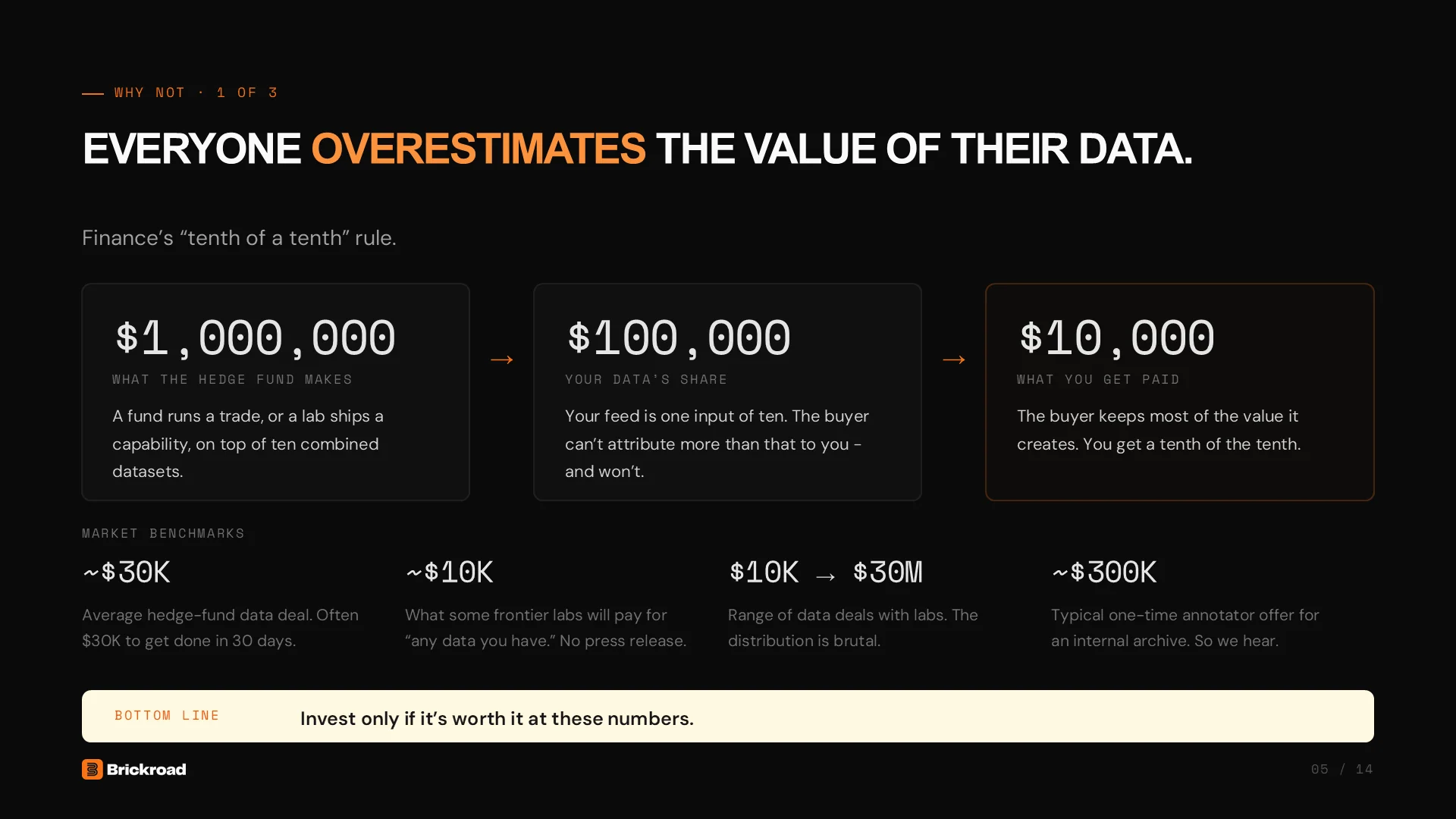
Finance has a rule for this. The tenth-of-a-tenth rule.
A hedge fund runs a trade on top of ten combined datasets. Call it a million dollars of P&L. Your feed is one input of ten, so the most the buyer can attribute to you, and they will attribute less, is a hundred thousand. And the buyer keeps most of the value it creates, because it did the work, took the risk, and could have bought a substitute. So you get a tenth of that. Ten thousand dollars. A tenth of a tenth.
The same math holds for a lab shipping a capability on top of ten data sources. The denominator is always bigger than you think, and the buyer always keeps the numerator.
Here is what the market actually clears at, so you can check my arithmetic against your plans:
- ~$30K is an average hedge fund data deal. The folk wisdom is "$30K to get done in 30 days," and it is not far off.
- ~$10K is what some frontier labs will pay for "any data you have." No press release. No logo.
- $10K to $30M is the honest range of data deals with labs. The distribution is brutal, and the $30M deals are not for a company's operations archive. They are for Reddit.
- ~$300K is a typical one-time annotator offer for an internal archive. So we hear. It is a good number until you remember it is one-time, and what you gave up for it.
The bottom line: invest only if the business is worth it at these numbers. Not at the numbers in the pitch deck of whoever is selling you an exclusive brokerage arrangement.
Lesson Two: everyone underestimates how long it takes
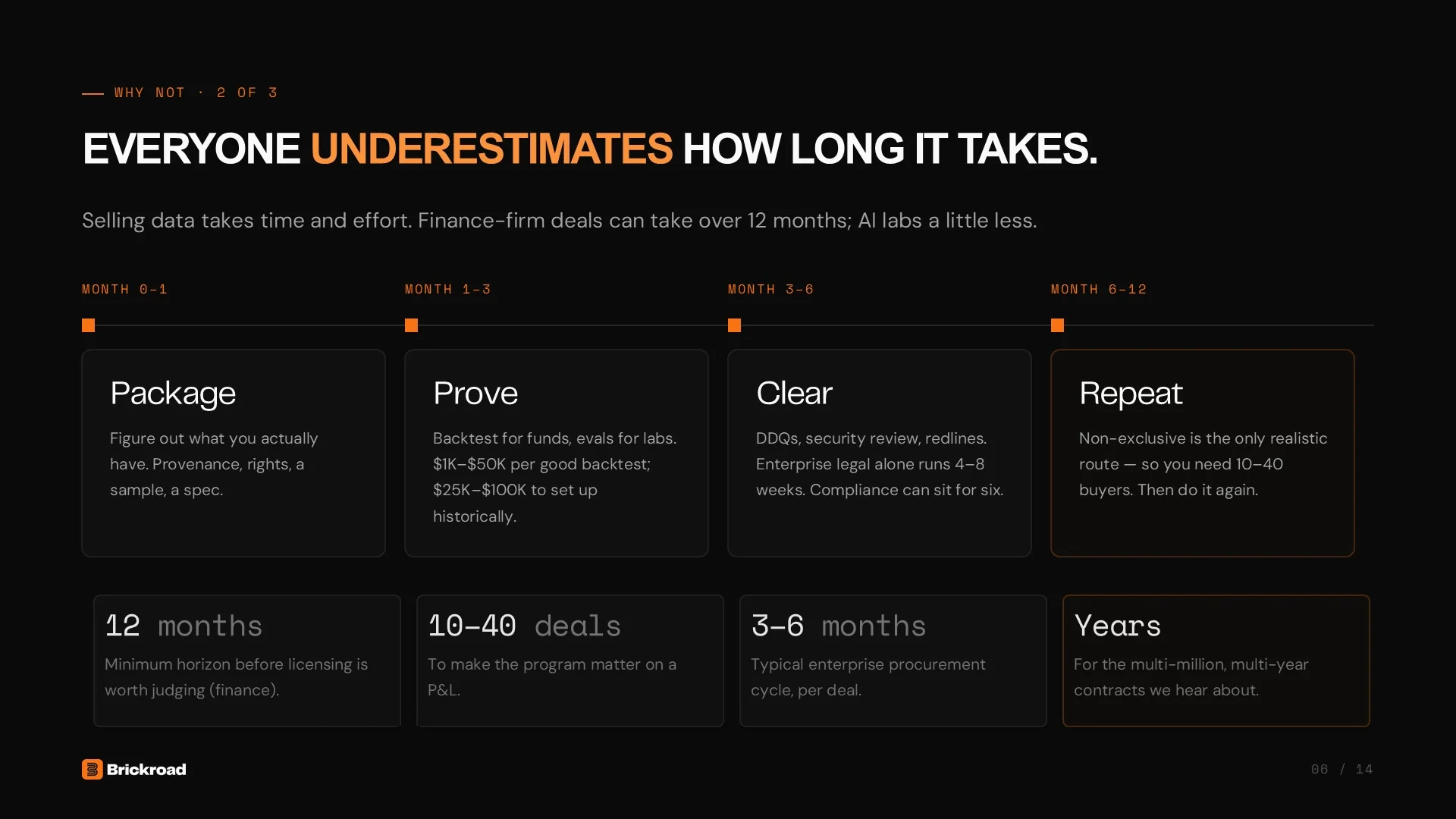
Selling data takes time and effort, and the time is not spent where first-time sellers expect. Finance-firm deals routinely take over twelve months. AI labs are a little faster, but not by as much as you would hope. The sequence looks like this:
Month 0 to 1: Package. Figure out what you actually have. Provenance, rights, a sample, a spec. Most companies have never written any of this down, and the exercise alone takes a month. Brickroad can do this in a couple of days.
Month 1 to 3: Prove. Backtests for funds, evals for labs. A good backtest costs $1K to $50K per run, and setting one up historically runs $25K to $100K. If you do not run it, the buyer runs it on their terms and reaches their own conclusion, which is almost always "we could reproduce this."
Month 3 to 6: Clear. Due diligence questionnaires, security review, redlines. Enterprise legal alone runs four to eight weeks. Compliance can sit on it for six.
Month 6 to 12: Repeat. Non-exclusive is the only realistic route, which means you need ten to forty buyers for the program to matter on a P&L. Then you do it again next year.
You cannot do this on the side.
Lesson Three: it is a distraction from the only thing that matters
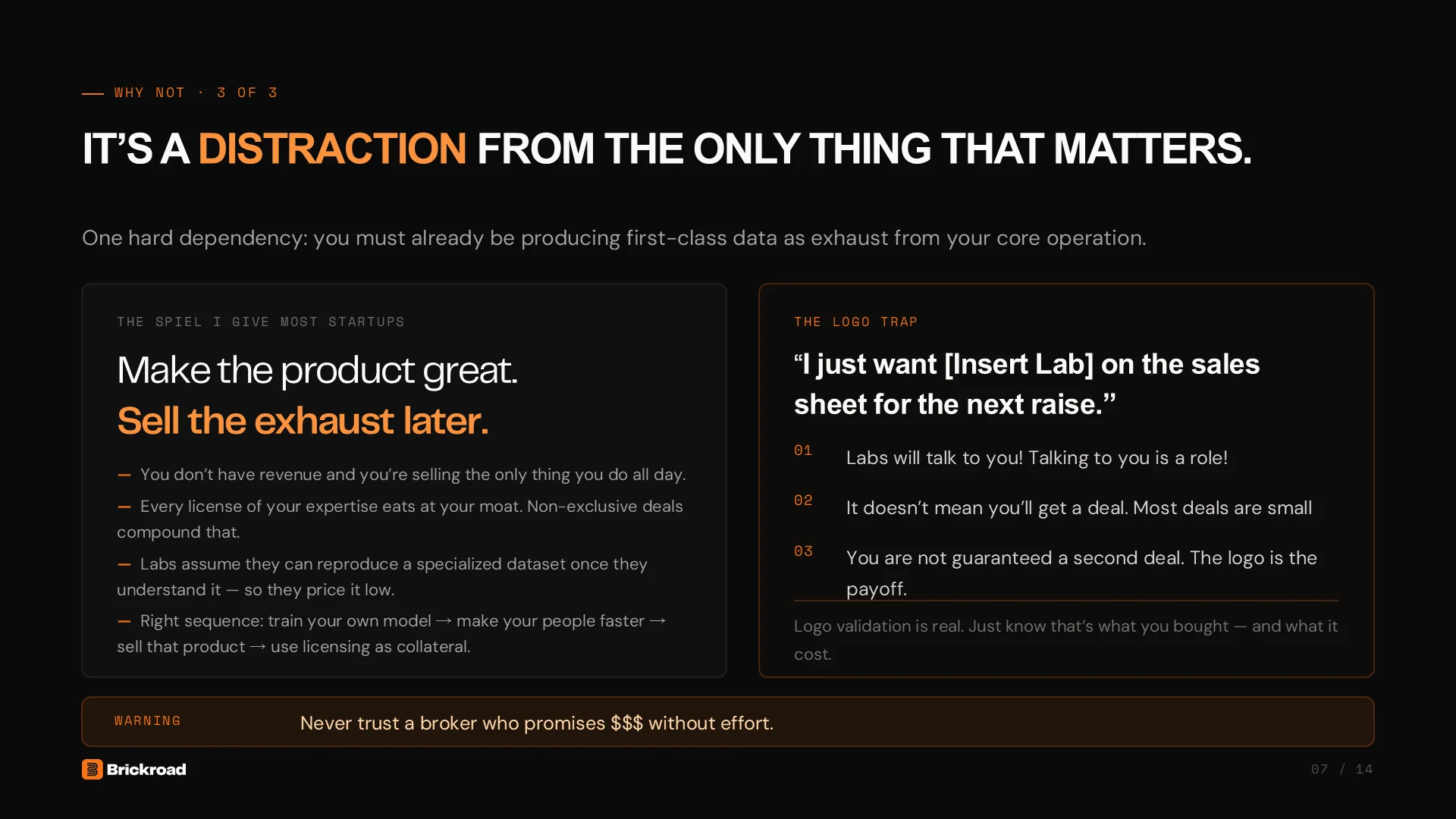
There is one hard dependency for a data licensing business: you must already be producing first-class data as exhaust from your core operation. If you are not — if you're testing the waters to decide what to license — you're neither ready, nor able, to deliver at the speed required by labs.
Thus, the spiel I give most startups is short. Make the product great. Sell the exhaust later.
The reasons are not complicated. If you are like many startups and you do not yet have significant recurring revenue, you are proposing to sell the only thing you do all day. Every license of your specialized data erodes the thing that made you special, and non-exclusive deals compound that erosion ten to forty times. Labs assume, correctly in most cases, that they can reproduce a specialized dataset once they understand it, so they price it as if they already have. And the sequence that actually works runs the other way: train your own model on your data, use it to make your own people faster, sell that product, and then, once the product has value, use licensing as collateral and upside rather than as the plan.
The logo trap
I want to spend a minute on the version of this I hear most often, which goes: "I just want [Insert Lab] on the sales sheet for the next raise."
Know this. Labs will talk to you. Talking to data suppliers is someone's full-time job at every lab, and they are good at it. Second, a conversation does not mean a deal, and most deals that do happen are small. Third, you are not guaranteed a second deal. The logo is the payoff. That is what you bought.
Logo validation is real, and I am not telling you not to buy it. I am telling you to know that is what you bought, roughly what it cost (think $10K and a release of your data), and to stop calling it a business line in the board deck.
Finally, outside of the above, one small rule: Never trust a broker who promises you dollars without effort. Many will charge for intros — few can truly make you market ready.
So when should you license?
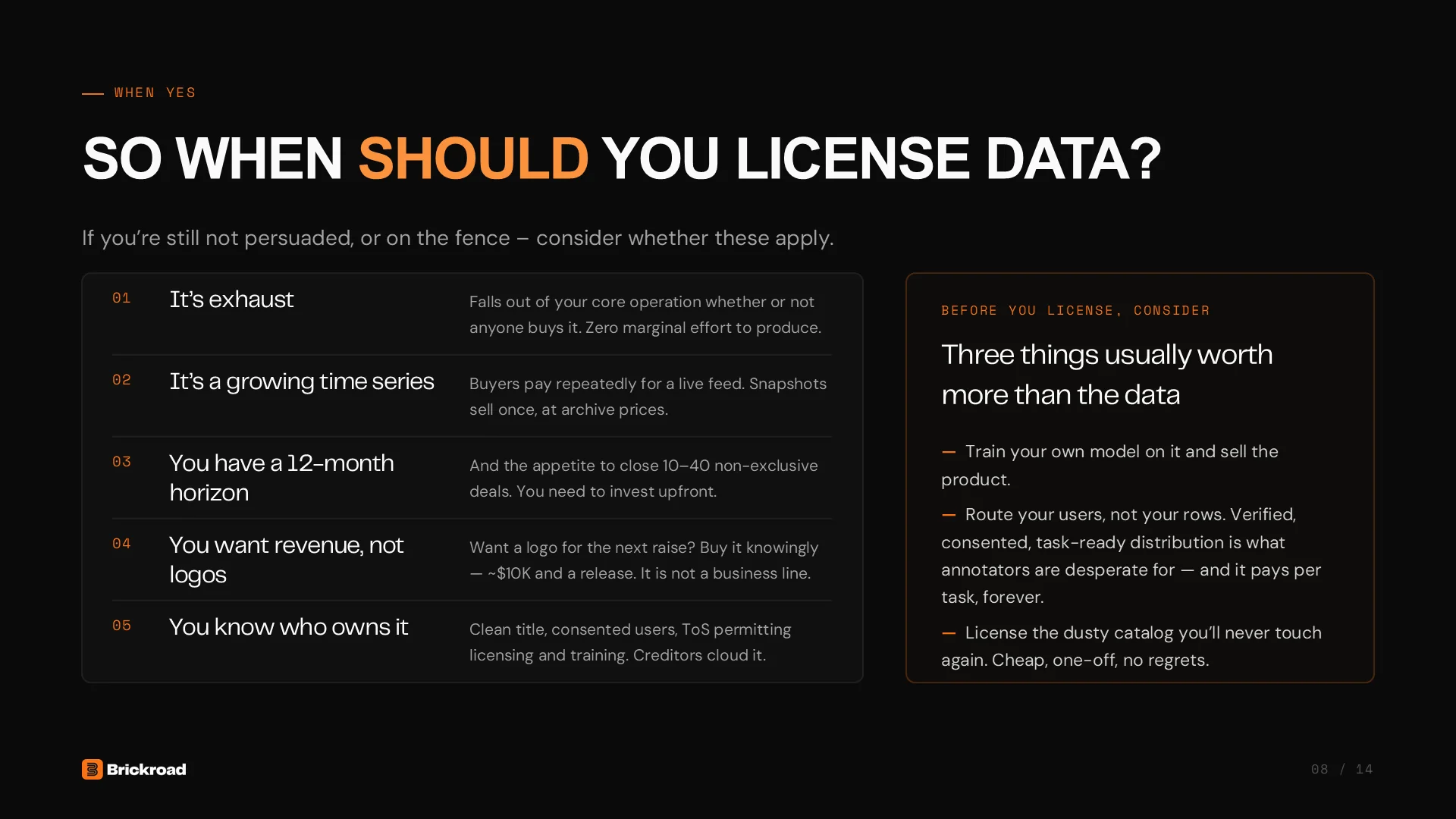
If you are still with me and still not persuaded, or genuinely on the fence, here are the five questions/conditions I'd consider. If all five apply, you may have a business. If three apply, you have a side project. If only one applies, you may have a distraction.
- It's exhaust. It falls out of your core operation whether or not anyone buys it. Zero marginal effort to produce. Nobody's job changes if the deal doesn't close.
- It's a growing time series. Buyers pay repeatedly for a live feed. Snapshots sell once, at archive prices, and then you are back to square one with a slightly smaller moat.
- You have a twelve-month horizon. And the appetite to close ten to forty non-exclusive deals, with real upfront investment in packaging and proof.
- You want revenue, not logos. If you want a logo for the raise, buy it knowingly. It is not a business line.
- You know who owns it. Clean title, consented users, terms of service that permit licensing and training. Creditors cloud it. Collaborators cloud it. "We think we own it" is not clean title.
Before you commit, consider three things that are usually worth more than the data itself:
- Train your own model on it and sell the product. The data is the moat. The model is the product. Selling the moat to fund the product is backwards.
- Route your users, not your rows. Verified, consented, task-ready distribution is what the annotators are desperate for, and it pays per task, forever, without ever handing over the archive.
- License the dusty catalog you will never touch again. Cheap, one-off, no regrets. The lowest-risk way to learn how this market works.
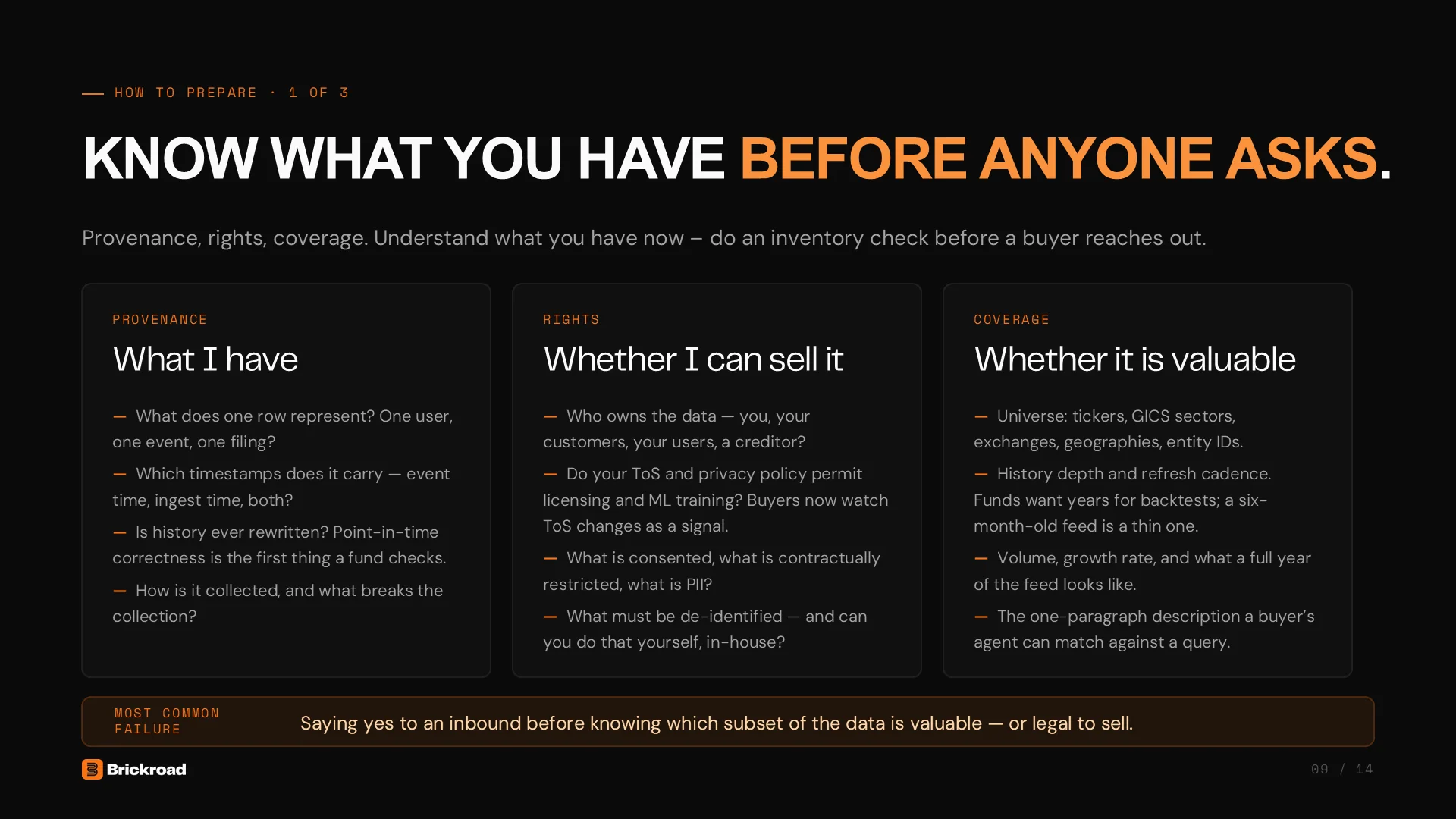
If you do: know what you have before anyone asks
The most common failure I see is saying yes to an inbound before knowing which subset of the data is actually valuable, or actually legal to sell. Do the inventory before the buyer reaches out, because once the buyer is in the room, you will not have time. That said, Brickroad can help understand your dataset and provide an uplift analysis if you're stuck.
Provenance: what do I have? What does one row represent? One user, one event, one filing, one assay? Which timestamps does it carry: event time, ingest time, both? Is history ever rewritten? Point-in-time correctness is the first thing a fund checks, and the first thing most operational databases get wrong. How is it collected, and what breaks the collection?
Rights: can I sell it? Who owns the data: you, your customers, your users, a creditor? Do your terms of service and privacy policy permit licensing and ML training? Buyers now watch ToS changes as a signal, so a quiet amendment the week before you go to market is not quiet. What is consented, what is contractually restricted, what is PII? What must be de-identified, and can you do that yourself, in-house, before anything leaves the building?
Coverage: is it valuable? Universe: tickers, sectors, exchanges, geographies, entity IDs, or whatever the equivalent is in your domain. History depth and refresh cadence. Funds want years for backtests; a six-month-old feed is a thin one. Volume, growth rate, and what a full year of the feed looks like. And the one-paragraph description that a buyer's agent can match against a query, because increasingly the first reader of your pitch is not a person.
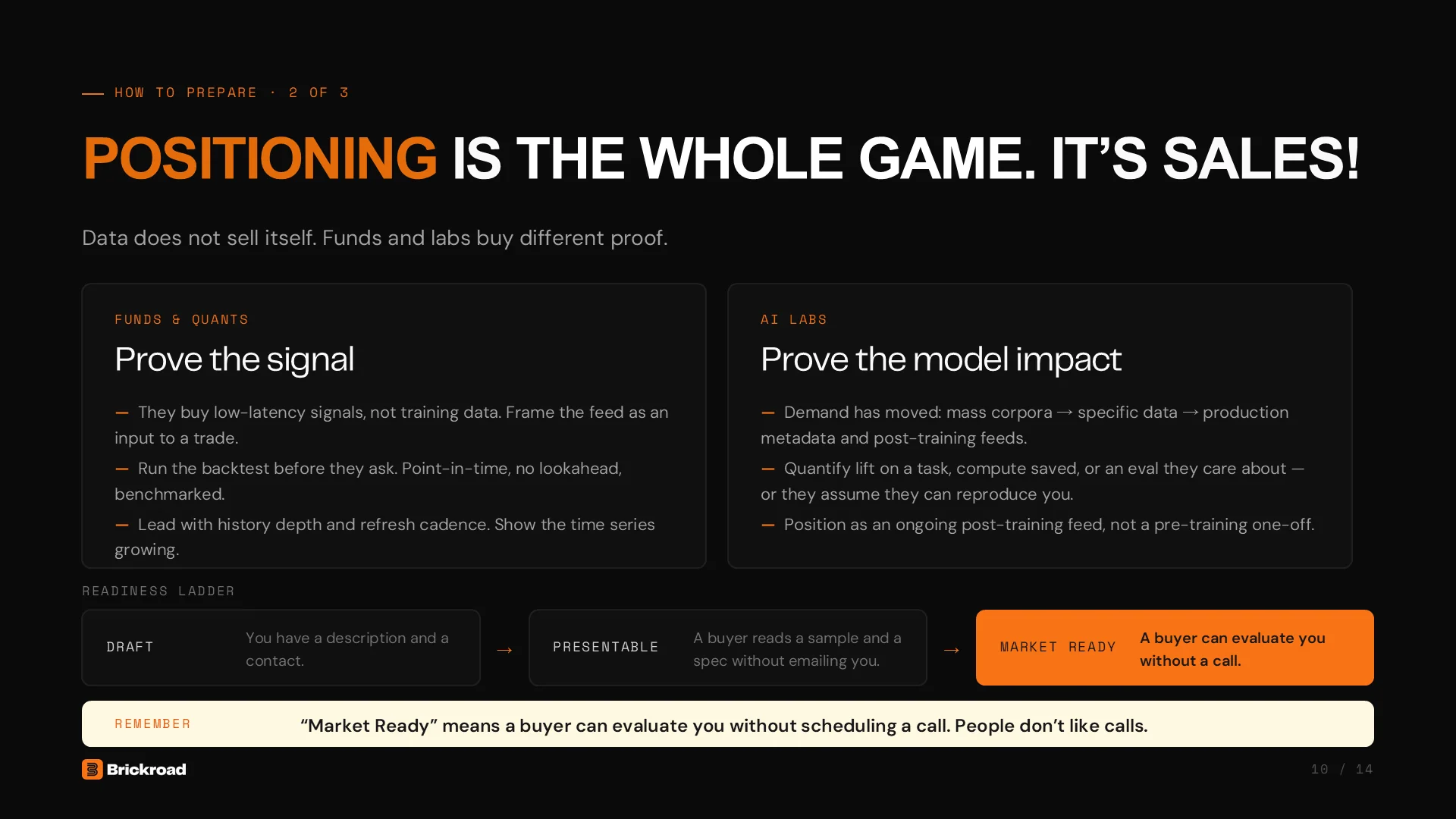
If you do: positioning is the whole game
Data does not sell itself. This is sales, and the two buyers you are most likely to meet buy completely different proof.
Funds and quants buy signal. They are buying low-latency inputs to a trade, not training data, and the framing has to match. Run the backtest before they ask: point-in-time, no lookahead, benchmarked against something they already own. Lead with history depth and refresh cadence. Show the time series growing.
AI labs buy model impact. And demand has moved. Two years ago it was mass corpora. Then it was specific, high-quality data. Now it is production metadata and post-training feeds. Quantify lift on a task, compute saved, or an eval they care about, or they will assume they can reproduce you and price accordingly. Position as an ongoing post-training feed, not a pre-training one-off.
I think about this as a readiness ladder with three rungs.
- Draft. You have a description and a contact.
- Presentable. A buyer can read a sample and a spec without emailing you.
- Market ready. A buyer can evaluate you without a call.
"Market ready" means a buyer can run their evaluation and reach a decision without scheduling anything. That is the bar. People do not like calls, and the engineer who is now your counterparty likes them least of all.
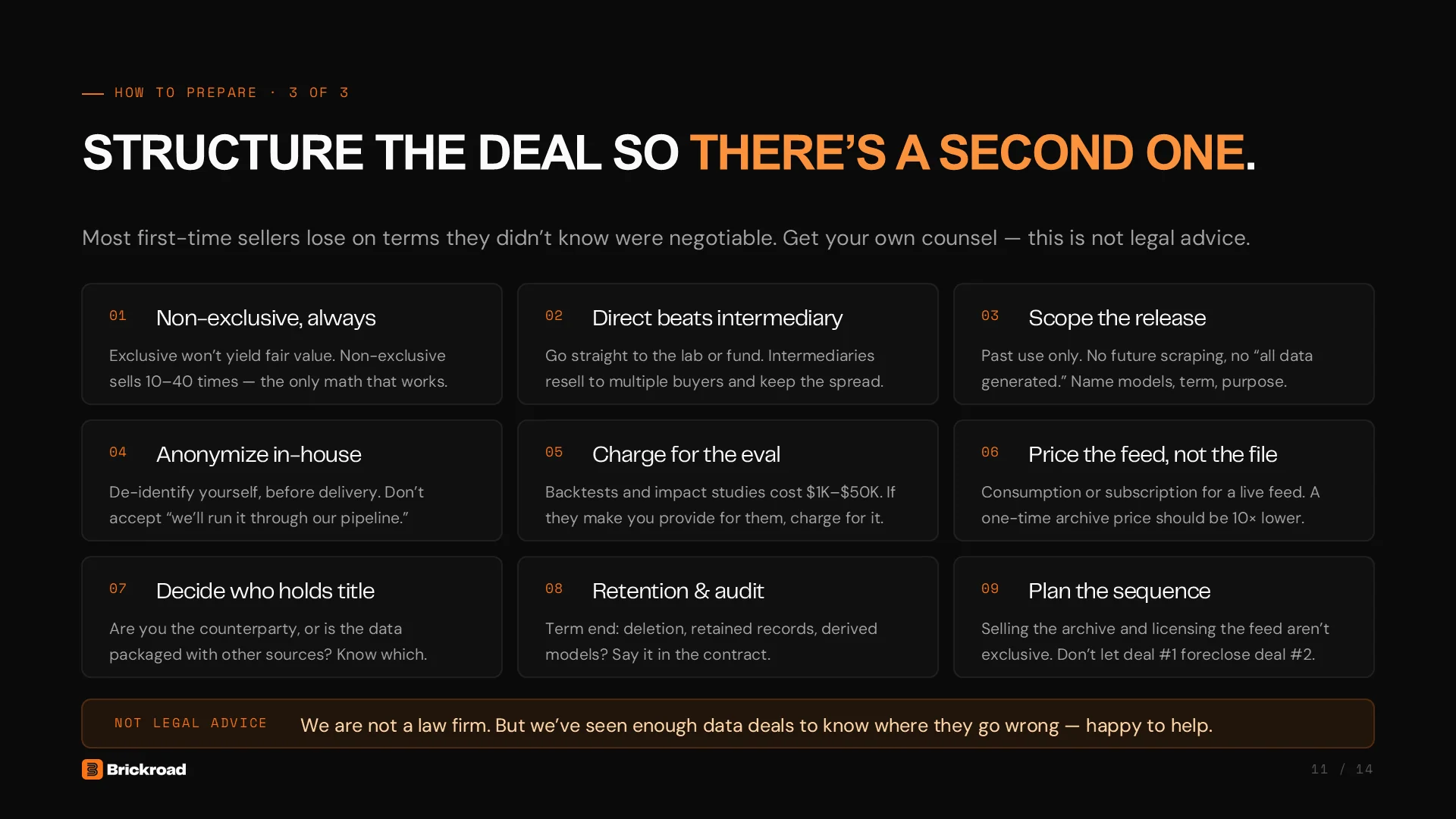
If you do: structure the deal so there is a second one
Most first-time sellers lose on terms they did not know were negotiable. Get your own counsel. This is not legal advice, but it is a list of the places I have watched deals go wrong.
- Non-exclusive, always. Exclusive will not yield fair value; the buyer is paying for an option on your entire future and pricing it like a single purchase. Non-exclusive sells ten to forty times, which is the only math that works. If you do go the exclusive route, x40 your price.
- Direct beats intermediary. Go straight to the lab or the fund. Intermediaries resell to multiple buyers and keep the spread. If you must use one, know what they are reselling and to whom.
- Scope the release. Past use only. No future scraping, no "all data generated." Name the models, the term, and the purpose. A release that covers "all data" covers data you have not created yet.
- Anonymize in-house. De-identify yourself, before delivery. Do not accept "we'll run it through our pipeline." Once it is in their pipeline, it is theirs.
- Price the feed, not the file. Consumption or subscription pricing for a live feed. A one-time archive price should be roughly ten times lower, because that is roughly what it is worth to you relative to the feed.
- Decide who holds title. Are you the counterparty, or is your data being packaged with other sources into something the intermediary owns? Know which, and know what that means for deal two.
- Retention and audit. What happens at term end? Deletion, retained records, derived models? Say it in the contract. If it is not in the contract, the answer is "they keep everything."
- Plan the sequence. Selling the archive and licensing the feed are not mutually exclusive. Just don't let deal one foreclose deal two. The archive release should not cover the feed. The feed license should not grant the archive.
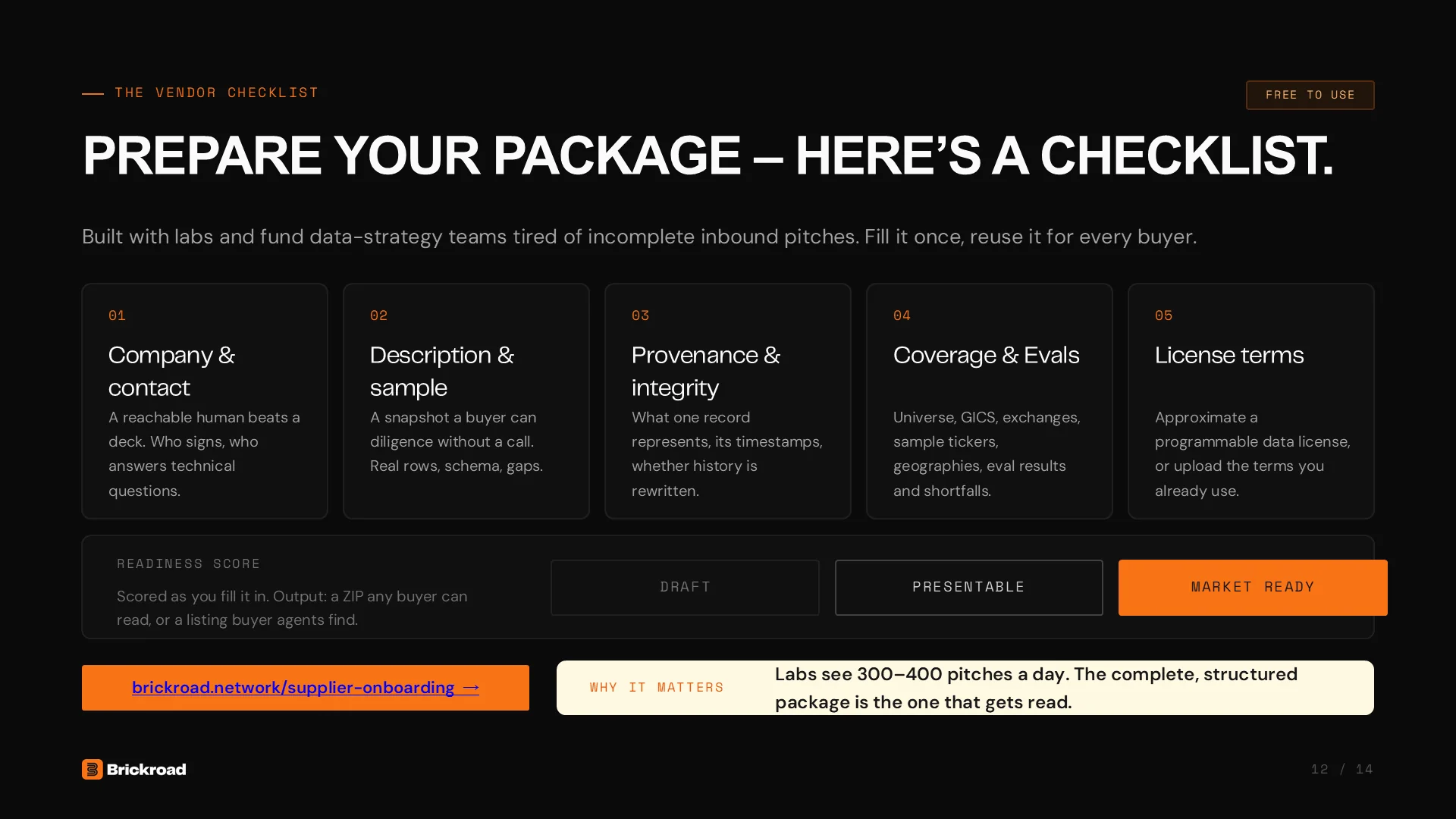
The vendor checklist
We built a checklist for this, with labs and fund data-strategy teams who were tired of incomplete inbound pitches. It is five sections, and it is free: company and contact (a reachable human who signs and a reachable human who answers technical questions), description and sample (real rows, schema, gaps), provenance and integrity, coverage and evals, and license terms. It scores your readiness as you fill it in, and the output is either a ZIP any buyer can read or a listing that buyer agents can find.
If you take one practical thing from this post, fill it in once and reuse it for every buyer. Labs see 300 to 400 pitches a day. The complete, structured package is the one that gets read.
You can find it at brickroad.network/supplier-onboarding.
Where this is going
I will end where the talk ended, with the reason I think any of this matters beyond the next twelve months.
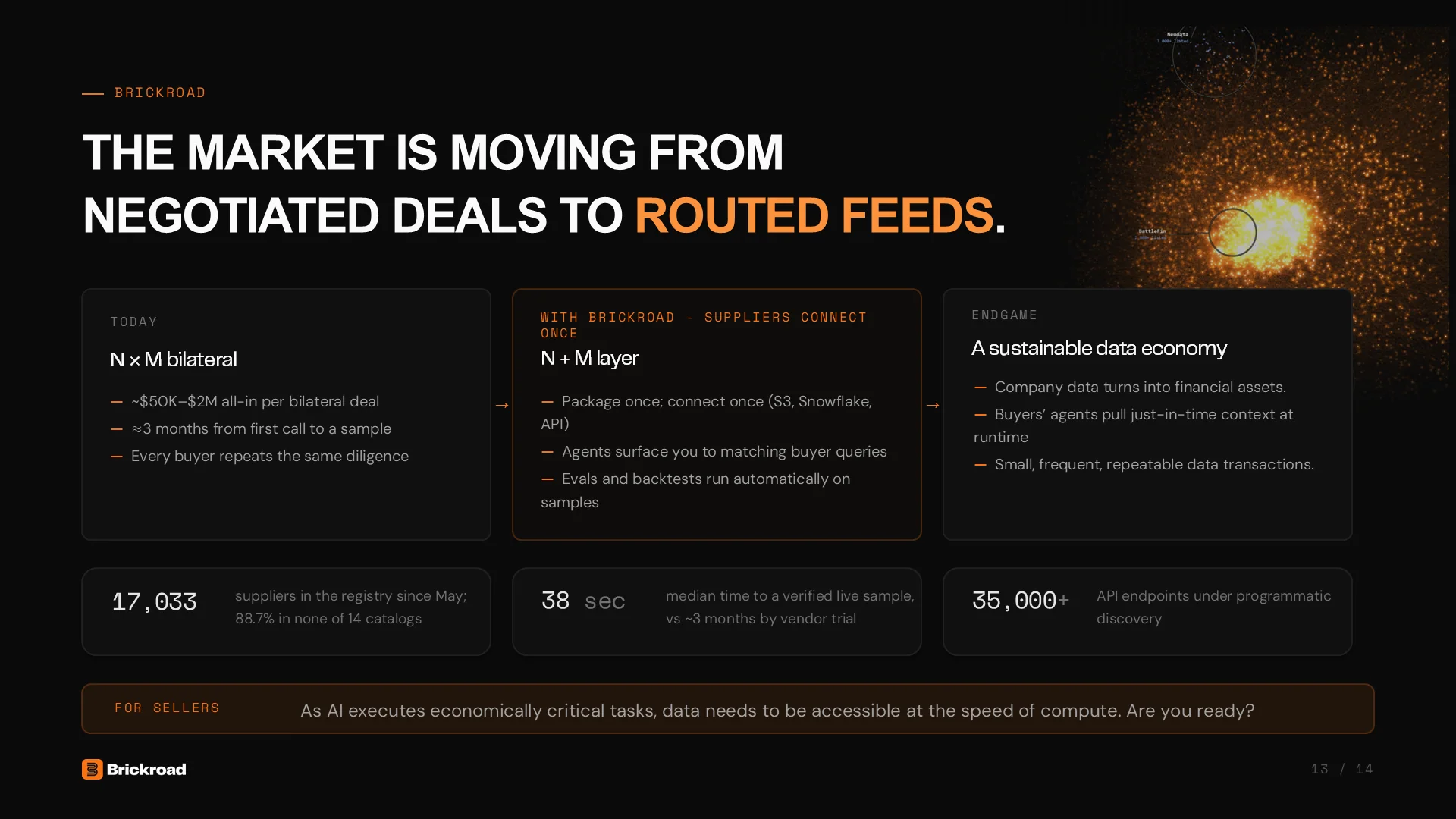
Today, every data deal is N × M: every buyer negotiates with every supplier, $50K to $2M all-in per bilateral deal, roughly three months from first call to a sample, and every buyer repeats the same diligence the last one did. That is often more than the deal itself is worth: remember the $30K average. That is the market you are considering entering, and it is the reason most of the advice above is about patience and legal fees.
It will not stay that way. The market is moving from negotiated deals to routed feeds. Package once, connect once, and let buyers' agents surface you against the queries they are already running, with evals and backtests executed automatically on samples. Company data becomes a financial asset. Buyers' agents pull just-in-time context at runtime. Transactions get small, frequent, and repeatable, which is the shape every other liquid market eventually took.
That is what we are building at Brickroad, and it is why I think the companies that set up their data licensing arms correctly today, as exhaust, as a time series, with clean title and a twelve-month horizon, will own a durable second revenue line for the next two decades. As AI executes economically critical tasks, data needs to be accessible at the speed of compute.
But the operative word in that sentence is correctly. Most of you shouldn't try. The rest of you should get market ready.
TL;DR
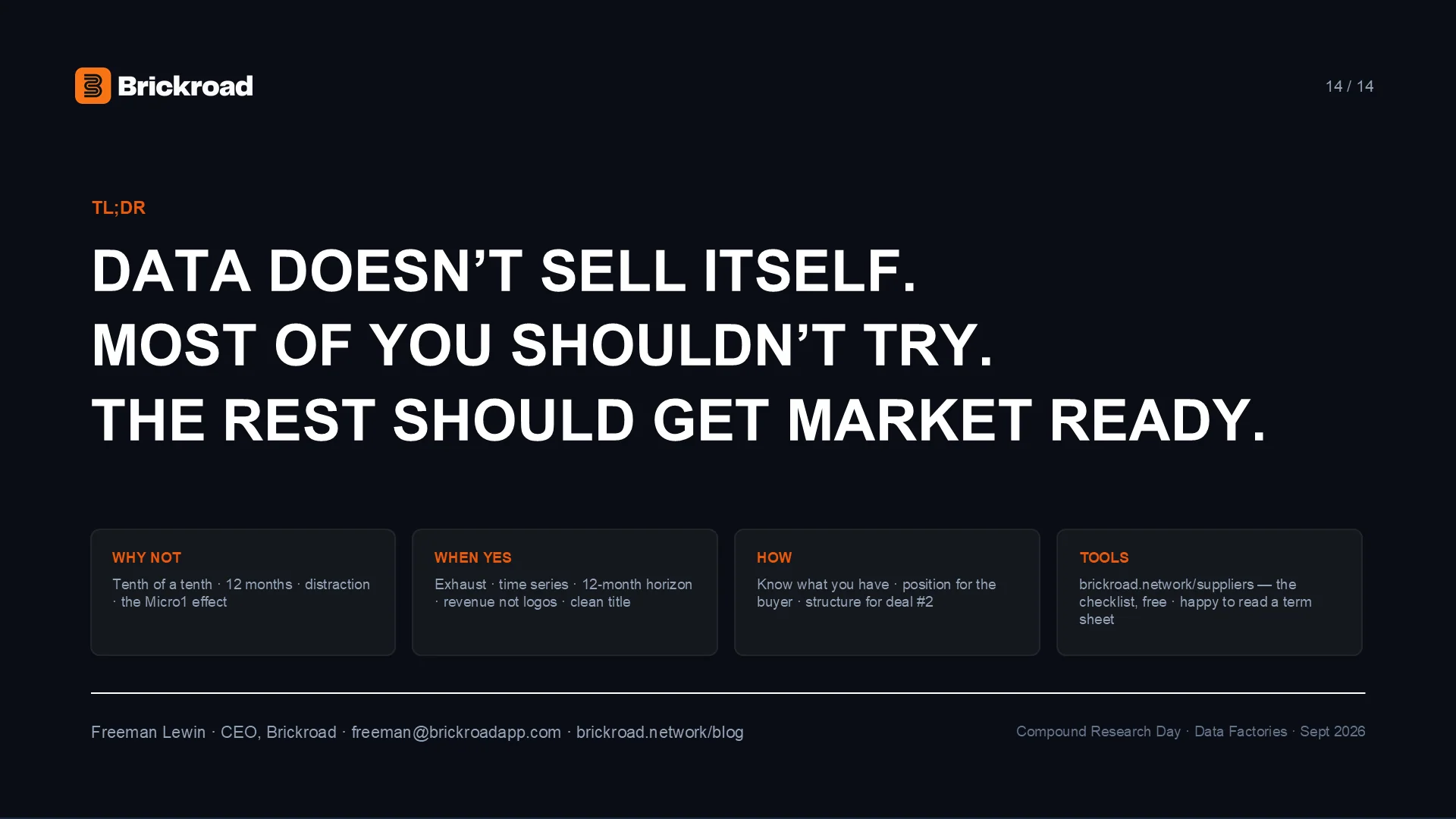
Data doesn't sell itself. Most of you shouldn't try. The rest should get market ready.
- Why not: tenth of a tenth, twelve months, distraction, the logo trap.
- When yes: exhaust, time series, twelve-month horizon, revenue not logos, clean title.
- How: know what you have, position for the buyer, structure for deal two.
- Tools: the checklist is free, and I am happy to read a term sheet. freeman@brickroadapp.com.
Frequently asked questions
Should I license my data?
Data licensing is not an easy revenue stream for most companies, and focusing on it early is often a distraction from building a great company. Great companies have great data that yields long-term deals. The exception is exhaust: data that falls out of your core operation every day whether or not anyone buys it. If your data meets the five conditions in this post, licensing may be a real business.
How much is my data worth?
Brickroad can help you put a number on it. We help with utility valuation and estimation: estimating the marginal utility of your data against the task a buyer cares about, so you can price and position it with evidence instead of guesswork. A good place to start is by understanding your data's impact. The more clearly you show this, the stronger your position — and we would be glad to help you measure the same. Book time with us to get started.
How long does it take to license data?
Longer than first-time sellers expect. Finance-firm deals routinely take over twelve months, and AI labs are a little faster. A deal runs through four stages: package (month 0 to 1), prove (months 1 to 3), clear (months 3 to 6) and repeat (months 6 to 12). Twelve months is the minimum horizon before licensing is worth judging in finance, ten to forty non-exclusive deals are what it takes to matter on a P&L, and a typical enterprise procurement cycle is three to six months per deal.
What does it mean to license your data?
It can mean four different things. A business operations archive is your system of records: the logs, transactions, assay results and support tickets your company produced. A catalog is prior work you will never touch again. Distribution is access to your verified, consented, domain-expert users doing tasks. Exhaust is data that falls out of your core operation every day at zero marginal effort. Which one you are licensing determines whether you have a long-term business or a one-time check.
When does licensing my data make sense?
When five conditions hold: it is exhaust, it is a growing time series, you have a twelve-month horizon and the appetite to close ten to forty non-exclusive deals, you want revenue and not logos, and you know who owns it, with clean title, consented users and terms of service that permit licensing and training. If all five apply you may have a business, if three apply you have a side project, and if only one applies you may have a distraction.
Should I sell exclusive or non-exclusive rights?
Non-exclusive, always. Exclusive rights will not yield fair value, because the buyer is paying for an option on your entire future and pricing it like a single purchase. Non-exclusive licenses can be sold ten to forty times, which is the only math that works. If you do go the exclusive route, multiply your price by forty.
Should I use a broker or a data marketplace?
Go direct to the lab or fund where you can. Intermediaries resell to multiple buyers and keep the spread. Marketplaces never cleared and catalogs do not clear, because someone still has to prove the value. Never trust a broker who promises dollars without effort: many will charge for introductions, but few can make you market ready.
What is the logo trap?
It is the goal of getting a lab's logo on your sales sheet for the next raise. Labs will talk to you, but a conversation is not a deal, most deals that do happen are small, and you are not guaranteed a second one. The logo is the payoff, and that is what you bought. Logo validation is real, but know that is what you bought and roughly what it cost, about $10K and a release of your data, and do not call it a business line.
What should I prepare before a buyer asks?
Take inventory in three columns. Provenance: what one row represents, which timestamps it carries and how it is collected. Rights: who owns it, whether your terms permit licensing and training, and what must be de-identified. Coverage: the universe, history depth, refresh cadence, volume and growth. Then climb the readiness ladder from draft, to presentable, to market ready, which means a buyer can evaluate you without a call. The most common failure is saying yes to an inbound before knowing which subset of the data is valuable or legal to sell.
What do hedge funds and AI labs look for in a data deal?
They buy different proof. Funds and quants buy signal: low-latency inputs to a trade, backed by a point-in-time backtest with no lookahead, history depth and refresh cadence. AI labs buy model impact: lift on a task, compute saved or an eval they care about, positioned as an ongoing post-training feed and not a pre-training one-off. If you do not quantify the impact, they will assume they can reproduce your data and price it accordingly.
What is the Brickroad vendor checklist?
A free five-section checklist built with labs and fund data-strategy teams who were tired of incomplete inbound pitches: company and contact, description and sample, provenance and integrity, coverage and evals, and license terms. It scores your readiness as you fill it in, and the output is either a ZIP any buyer can read or a listing that buyer agents can find. Fill it in once and reuse it for every buyer at brickroad.network/supplier-onboarding.
Book time with us
Pick a time that works for you. We can talk through what your data is worth, how to get it market ready, or whether to license it at all.
Calendar not loading? Open it in a new tab.