The Data Supplier Checklist: How to License Data, and Keep Getting Paid After the First Deal
Licensing data comes down to being prepared. When buyers diligence a dataset, they do so in a predictable order. Most first-time sellers lose the deal on questions they could have answered in advance. So with that – here’s a brief primer on how to license data for the long run.
Many first-time data licensors think the hard part is finding a buyer. It isn't. The hard part starts once a buyer is interested and begins asking questions. Many data licensors fail at this step because they are simply not ready to license their data.
We saw this first hand – that’s why we developed this Data Supplier Checklist, in conjunction with several of the world’s leading data strategists, to help new suppliers as they come online.
Who are you? What exactly is in this dataset? How is it collected, and what timestamp does each record carry? Can I see a sample? What will it do for my task? What are the terms? Is any of it legally risky?
You should expect to be answering these questions upfront every single time. A seller who can't answer them concisely quickly loses the deal. It is not about who has the better dataset at this stage, it’s about who’s better prepared.
We built a checklist around those questions: the supplier information package at brickroad.network/supplier-onboarding. This post walks through it and explains why each question gets asked. It also makes one argument the checklist can't make on its own: the work that gets you market ready is the same work that decides what your data is worth, and what it keeps earning after the first sale.
What "market ready" means
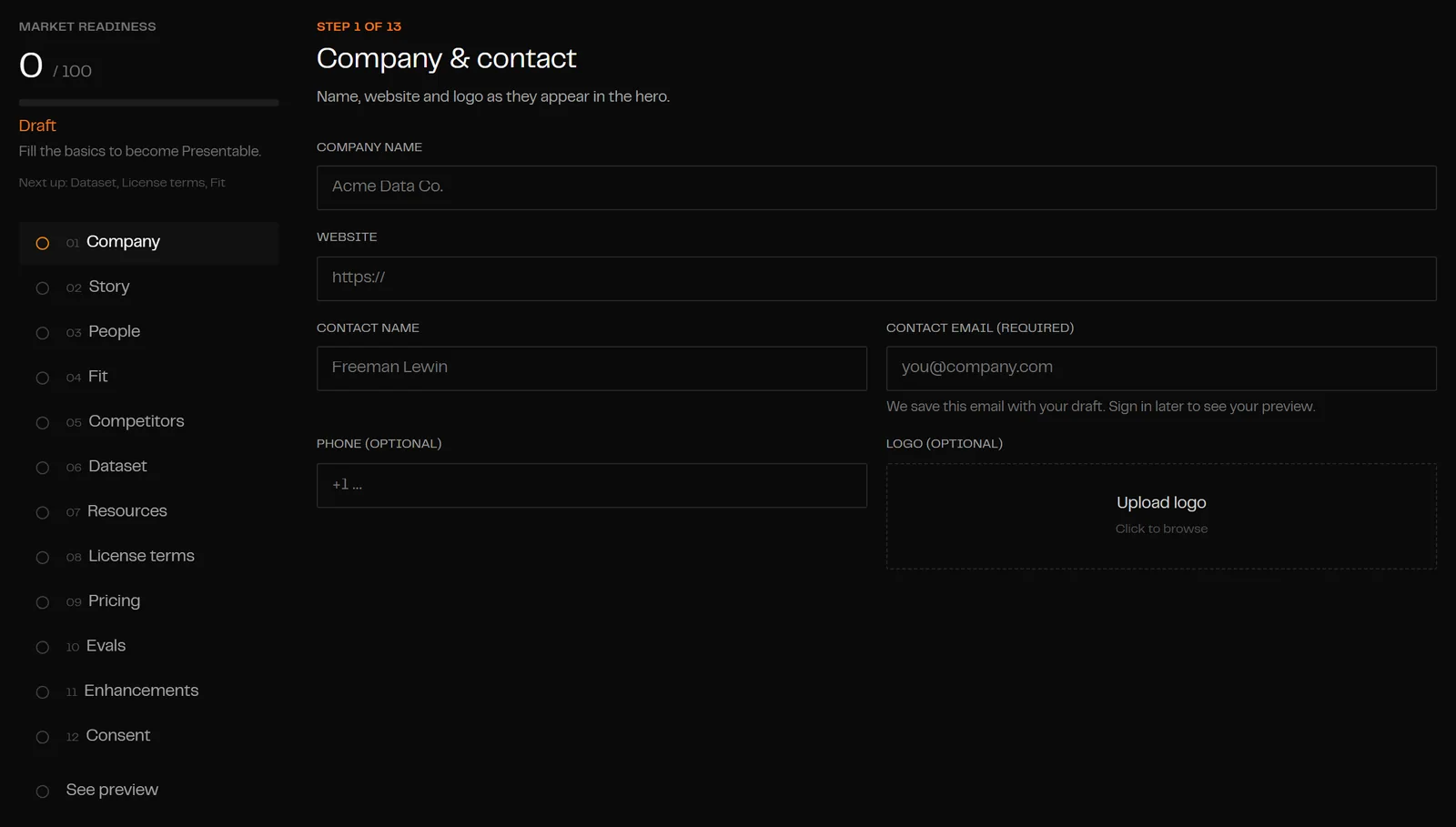
Our supplier onboarding questionnaire has three states: Draft, Presentable, and Market Ready. The test is simple. You are market ready when a buyer can evaluate you without scheduling a call.
Think about it this way – every call that a buyer has to schedule to learn something basic is a place the deal can stall. Your aim is to quickly qualify a lead, and close – that’s it. With that – here are some tips:
1. Be credible
Company and contact. Name, website, logo, and a named human. Buyers need a reachable person more than a polished deck. Nobody wants to be the first to try a dataset from an anonymous inbox.
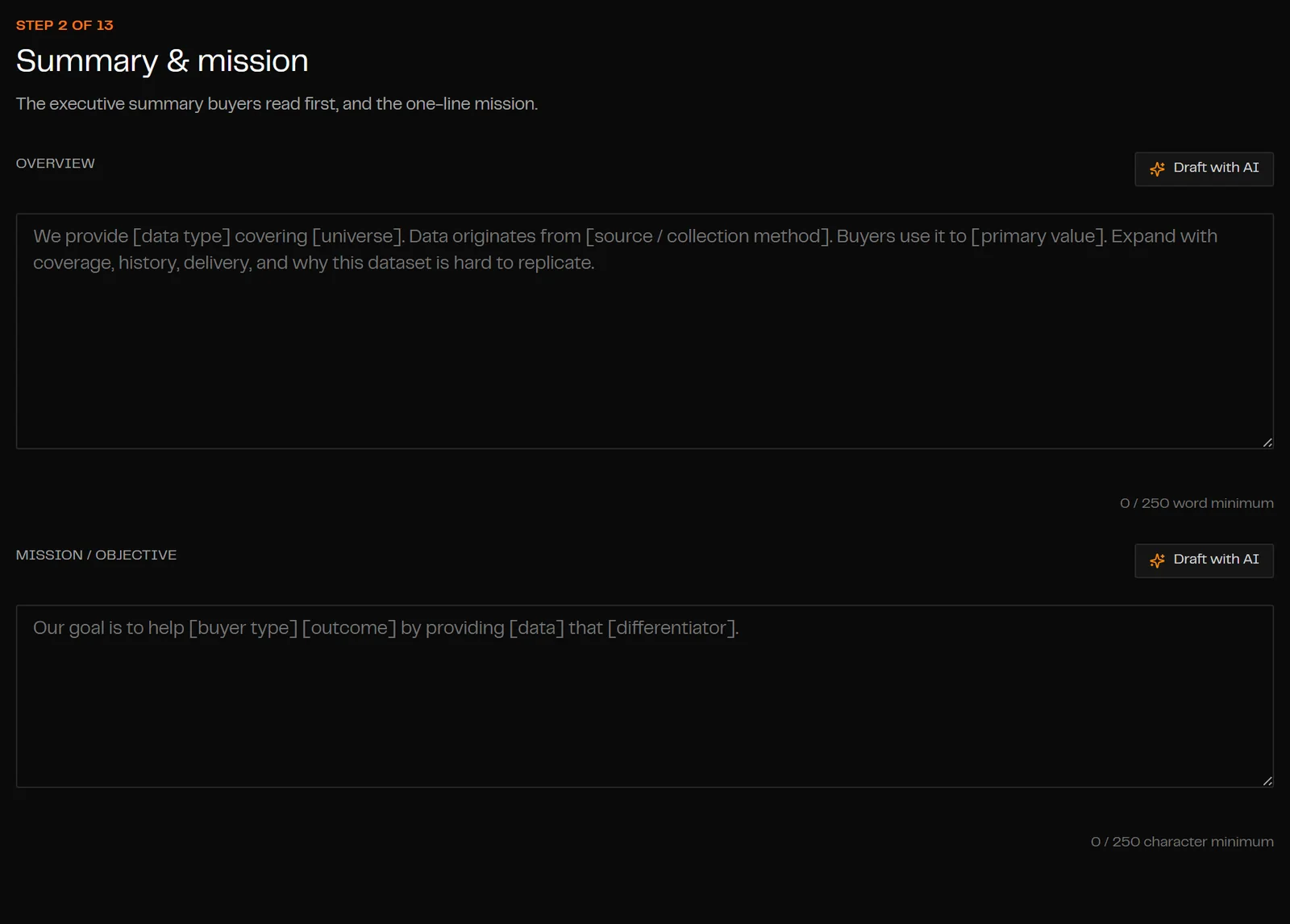
Summary and mission. The executive summary is the first thing a buyer reads, so write it to a template: We provide [data type] covering [universe]. Data originates from [source or collection method]. Buyers use it to [primary value]. Then add what makes it hard to replicate. Coverage, history and delivery go here, in one short paragraph.
Founders and product owners. Who will the buyer talk to, and why should they trust that person with their pipeline? Names, roles, and a short bio each.
Competitors. Say who buyers compare you with and how you differ. Leaving this blank doesn't stop the comparison – it guides it towards a narrative you can’t control.
2. Describe the data precisely
This is where most packages are thinnest, strangely.
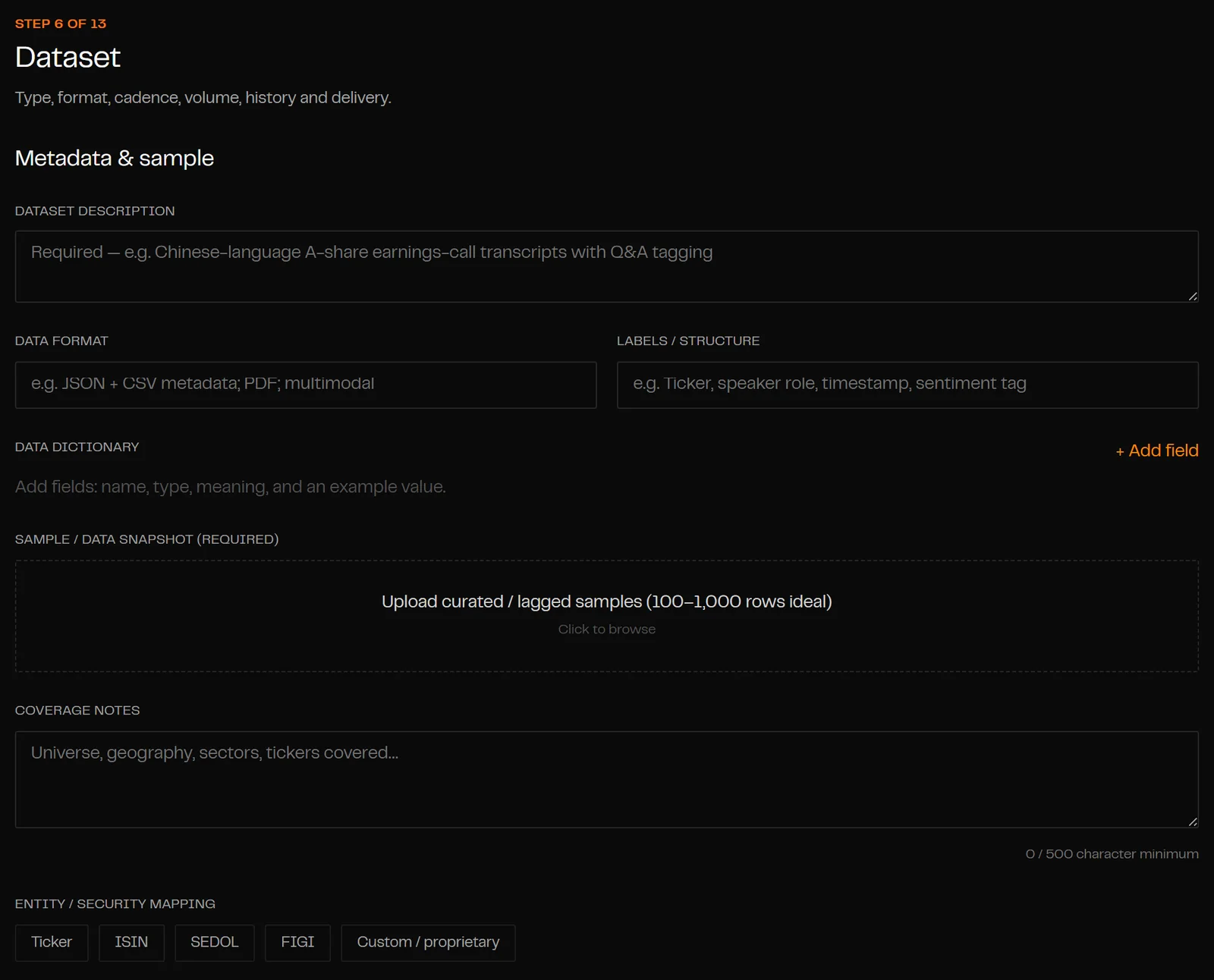
Type, format and structure. What kind of dataset it is, how it's delivered, how it's labeled, how much there is, how often it updates, how far back it goes, and whether it's still growing. Add a data dictionary and schema: every field, what it means, and its type. Brickroad’s supplier onboarding requires one to reach Market Ready – it can save engineers weeks of guessing.
Provenance. What one record represents, and where the data comes from: your own systems, web collection, a panel or survey, a vendor feed, human annotation, model generation, or something derived.
Timestamps. Say which time each record carries: when the event happened, when you collected it, when it was published, or when it was revised.
Point in time. Can the history be reconstructed as it was known on a given date, or does it only show the latest values? If you rewrite history when you correct errors, say so.
Coverage and identifiers. For financial data: sectors, instruments, exchanges, sample tickers, and how records map to ticker, ISIN, SEDOL or FIGI.
Before you fill this section in, it’s worth reading Pivotal's On Data Quality: The Fundamentals. Quality is a ladder. A buyer feels it when you skip a rung.
3. Say who it's for
Use cases and buyers. Concrete scenarios, and the personas the data is built for: quant funds, quantamental and fundamental managers, sell-side research, corporate buyers, data platforms and aggregators.
Be specific, and be generous. A use case you didn't list is one a buyer can't ask about. Sellers failing to identify the complete corpus of useful buyers is one reason why we see so many leaving value on the table.
4. Decide how you sell it
Pricing and licensing. A price band, a trial policy, and the license models you'll offer: an enterprise annual license, dashboard access, a lagged feed, consumption-based pricing, republishing rights. These aren't alternatives. Several can run at once, to different buyers, on the same data.
License terms. Decide on them in advance, or describe them by tagging the parameters of the Programmable Data License in the supplier onboarding flow. Think about whether the licensed data can be used to train models, whether trained models survive termination, what rights attach to model outputs, whether derivatives are allowed and on what terms, and whether the license is exclusive, for how long, and where.
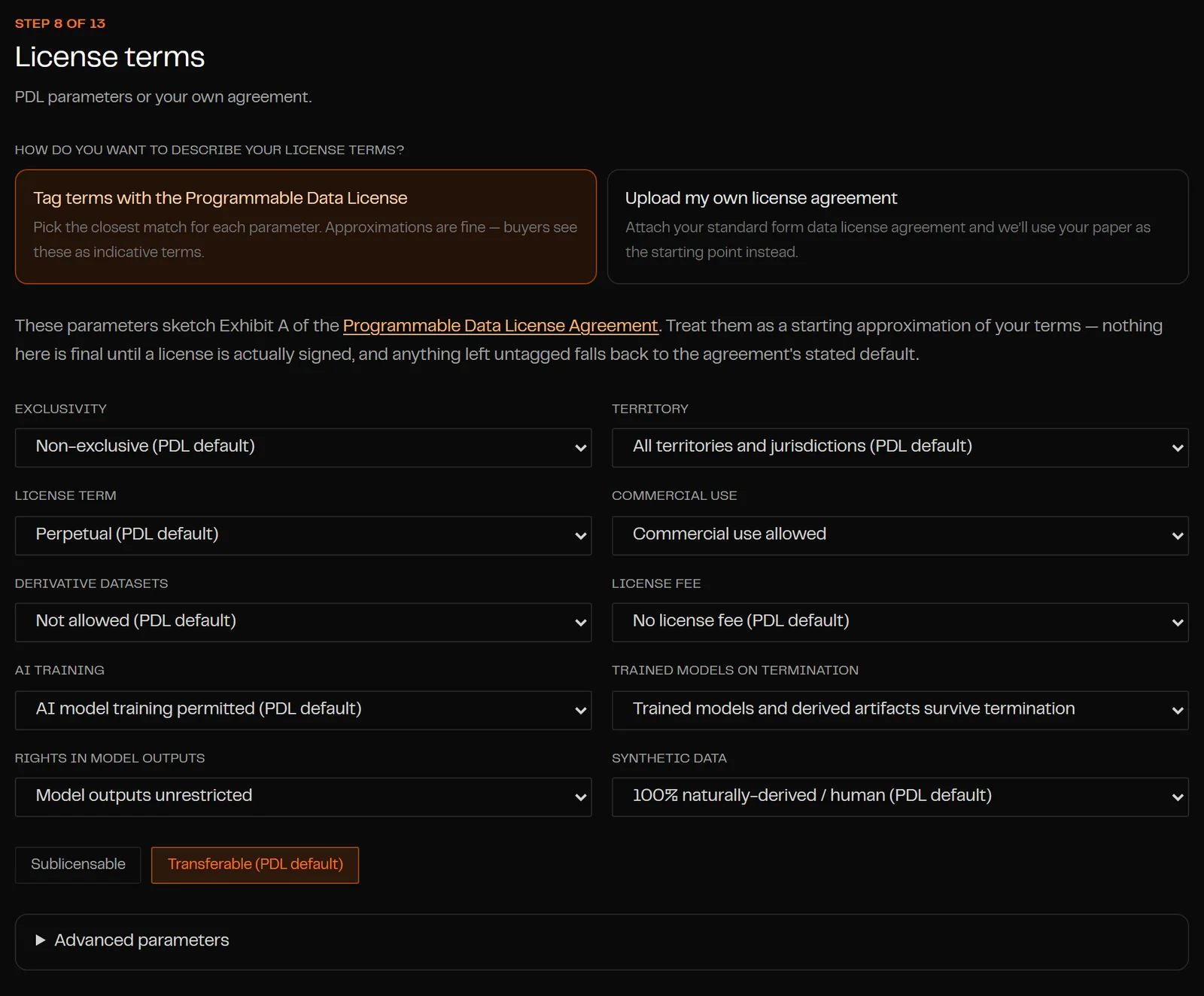
Approximations are fine. Buyers see these as indicative, not final. What matters is that you've thought about it before the buyer's lawyer does.
5. Prove it
This is the step that separates a package that gets read from one that gets bought. It is also where Brickroad does the most for you.
A description tells a buyer what the data is. A sample tells them what it looks like. Neither tells them what it will do for their work, and that is the only question that sets the price.
Samples and live access. Give buyers something to test. Register a sample endpoint and anyone who finds you on the network can pull live sample rows in one click, with your key kept server-side. Listings buyers can test move faster than listings they have to ask about.
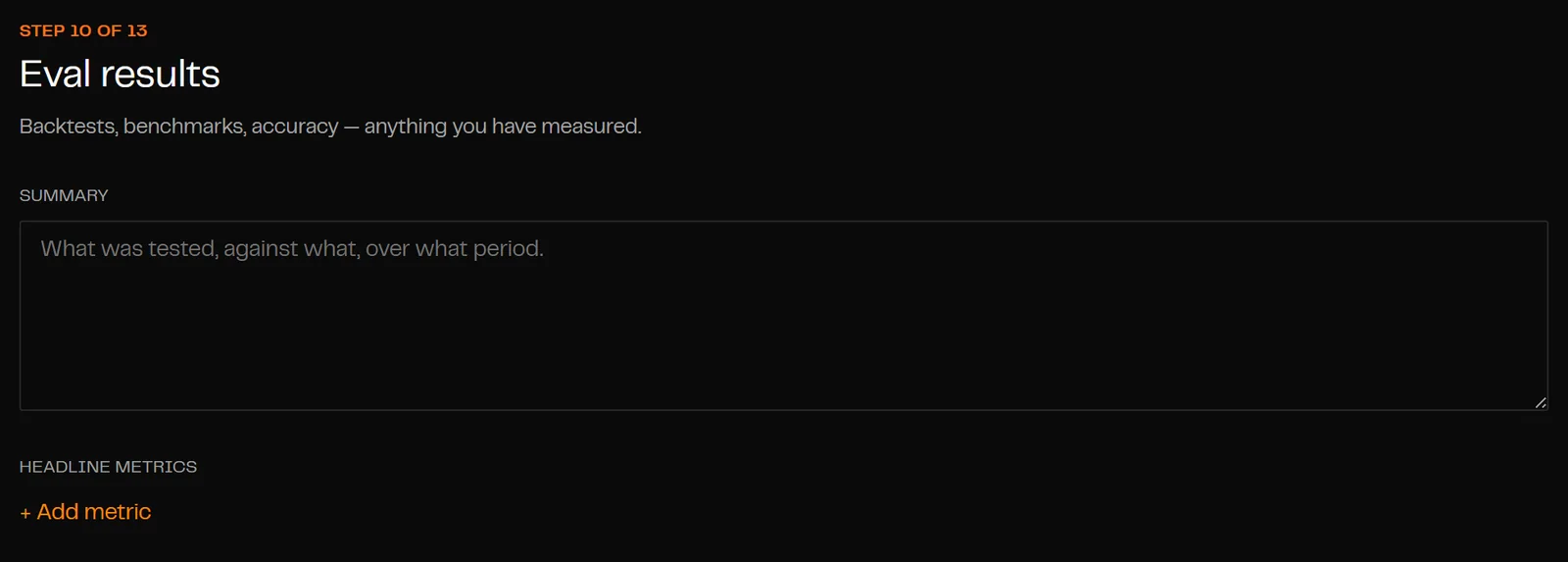
Evals. Backtests, benchmarks, accuracy, anything you have measured. Most suppliers have measured little, and what they have measured they ran themselves, which buyers discount. An independent eval, with the method written down, is the strongest asset you can bring to a sales conversation.
Uplift. The number a sophisticated buyer actually wants isn't how good your data is. It's how much better their results get when they add it. A dataset that duplicates what the buyer already holds is worth close to nothing to them, however good it is. A dataset that adds something new is worth a lot. Uplift analysis measures that gap. It is the difference between pricing on guesswork and pricing on evidence.
Utility and market valuation. Once you know what the data does, you can price it. We estimate the utility of your data against the task a buyer cares about, then set that against the market: what comparable datasets sell for, which license models fit, and who is most likely to see the value. You walk into the negotiation with a number you can defend, not one that felt reasonable.
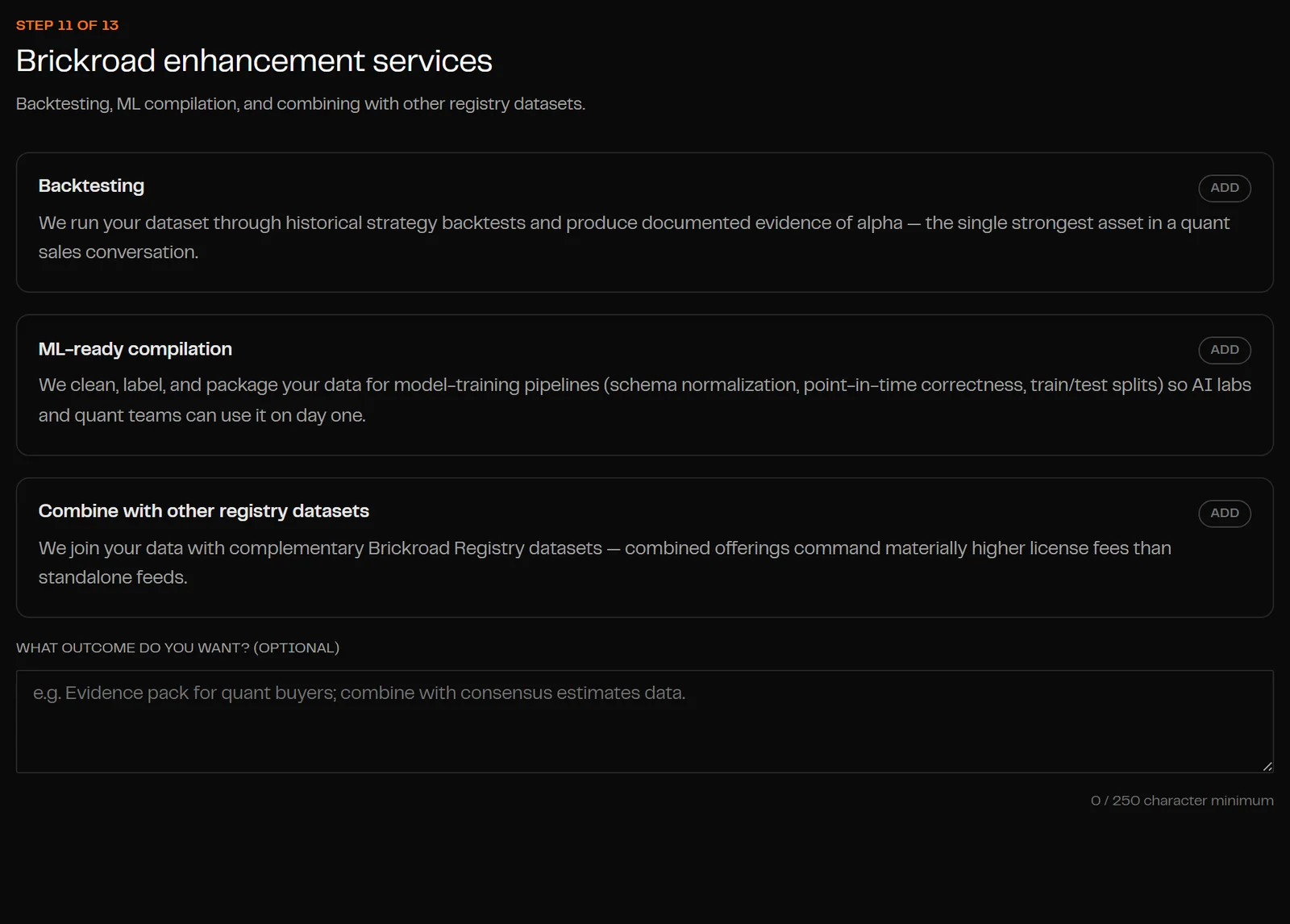
Evals, uplift analysis, and utility and market valuation are how Brickroad helps suppliers become market ready and get paid properly once they are. We also offer the enhancements the package lists: backtesting that produces documented evidence of alpha, ML-ready compilation that cleans, labels and packages data for training pipelines, and combination with other datasets on the network, because combined offerings command materially higher fees than standalone feeds.
If you do only one thing on this list that you wouldn't have done anyway, do this one. It's where your data stops being a description and becomes a result.
6. Be clean
Compliance. Ask yourself in advance:
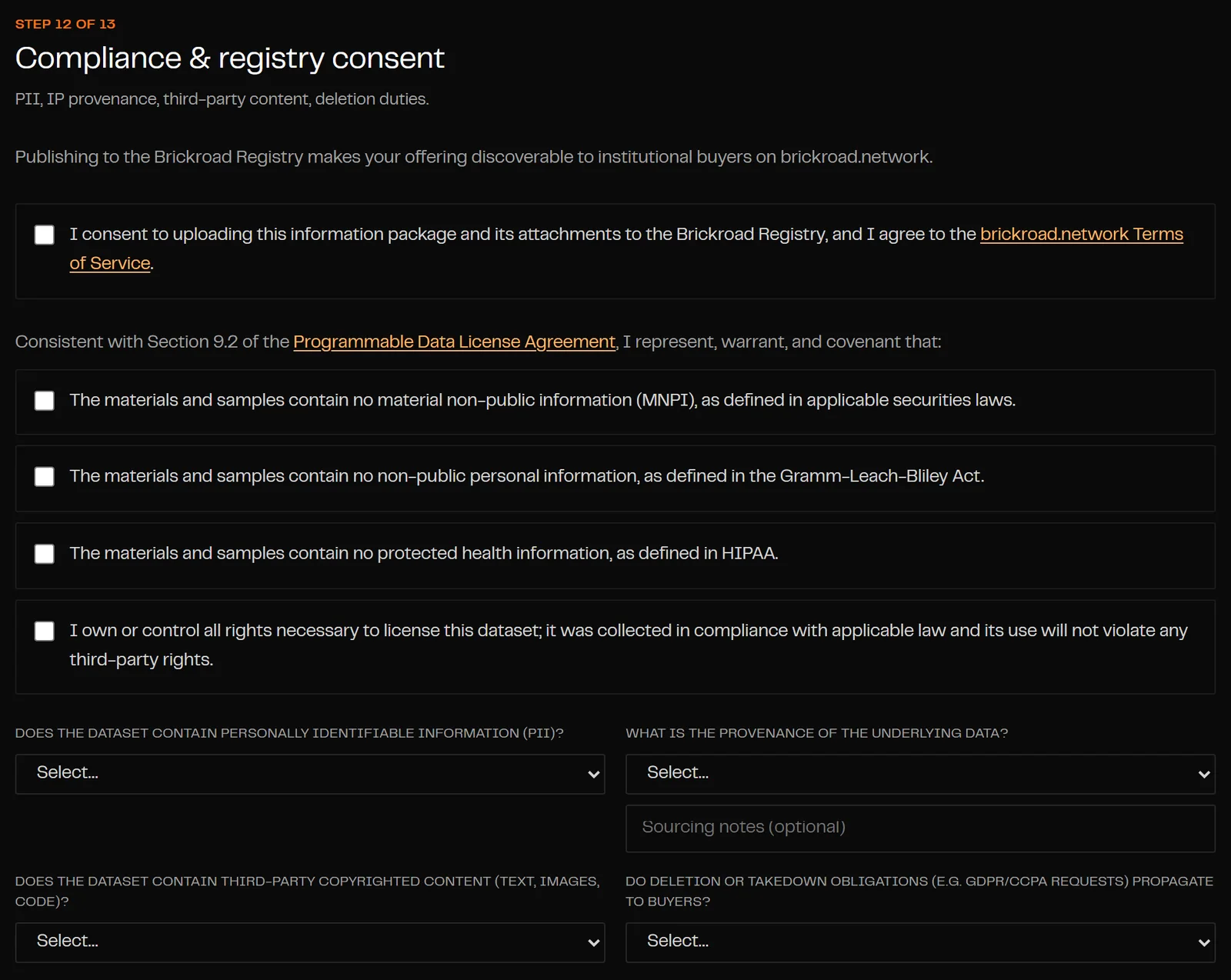
- Does the data contain material non-public information, non-public personal information, or protected health information?
- Do you own or control the rights to license it?
- Does it contain personal data, and if so, how is that mitigated?
- Where did it come from: first-party, licensed, aggregated from public sources, or mixed?
- Does it include third-party copyrighted content?
- Do deletion or takedown requests propagate to the buyer?
Answer each one in writing before anyone asks. A clean answer closes a question. An unclear one opens a review.
Resources. Docs, decks, papers, anything a buyer will want in the room. If you already have a deck, upload it. The package reads your documents and drafts the empty fields for you to review, so you don't start from a blank page.
Market ready is where the revenue starts
The first deal is not the goal. It's a proof point. Plenty of datasets sell once, at a price the buyer chose, and then the conversation ends. Sellers who build real businesses treat the package as an asset they keep sharpening. As we argued in You Probably Shouldn't License Your Data, the question isn't whether you can close the first license. It's whether you structured it so there's a second one.
- Renewals get easier with proof. A buyer deciding whether to renew is asking whether the data earned its fee. If you can show measured impact, you aren't asking them to take your word for it. If you can't, you're negotiating against their budget review.
- Recurring Data = Recurring Revenue: Index on datasets that continuously update and are critical to economically valuable tasks. Once you’re there, you become fundamental data.
- Every improvement is a reason to reprice. More history, wider coverage, a cleaner schema, a point-in-time upgrade: each changes what the data does, and a refreshed eval says by how much. Without one, you ask for the same price in year three that you asked in year one.
- Combined offerings earn more. Joined with complementary datasets, your data does things it can't do alone, and the fee reflects that. That's a recurring product, not a one-off.
- The network keeps looking. Buyers' agents search the network continuously. A complete, current package is one they can evaluate without a call, which means you can be found, tested and considered while you're doing something else.
None of this needs a bigger sales team. It needs a package a buyer can trust, backed by evidence that stays current. That is what market ready is for.
What to do next
Start the package. Upload a deck or a sample, let Brickroad draft the empty fields, review what it suggests, and see your preview as a buyer would, before paying anything. Start at brickroad.network/supplier-onboarding.
If you want help with the part that moves the price, book time with us. We run evals and uplift analysis on supplier data and put a defensible utility and market valuation behind it, so you price on evidence and go into the first negotiation knowing your number. Then we keep it current, so the second deal is easier than the first.
Frequently asked questions
What does "market ready" mean for a data supplier?
Market ready means a buyer can quickly and efficiently evaluate your dataset without scheduling a call. Your company and people are named, the dataset is described precisely, a sample is available, license terms are stated, compliance questions are answered, and there is evidence of what the data does for a buyer's task. Brickroad’s supplier onboarding follows this path by scoring a package as Draft, Presentable or Market Ready as you fill it in.
What is an eval, and why does a supplier need one?
An eval measures what your data does for a specific task, such as a benchmark for a model. Sophisticated buyers make decisions based on the impact of a dataset, not on its description, so a documented result is the strongest thing you can put in front of them. Brickroad runs evals on supplier data so the evidence is independent and the method is written down.
What is uplift analysis?
Uplift analysis measures what your data adds on top of what a buyer already has. A dataset that is impressive on its own but redundant with the buyer's existing sources is worth little to them; a dataset that moves their results is worth a lot. Brickroad measures that difference so you can price against the improvement instead of guessing.
How does Brickroad value a dataset?
We estimate the utility of your data against the task a buyer cares about, then set that against the market: what comparable datasets sell for, and which license models fit. The result is a price and a positioning you can defend with evidence, along with the buyers most likely to see the value.
How does licensing become recurring revenue?
Recurring revenue comes from renewals and ongoing updates. A renewal is far easier when you can show usage and measured impact over time. Datasets which are constantly updated and assist in shaping real-time outcomes that impact economically valuable tasks are those which command recurring revenue. Brickroad helps businesses understand their data and build datasets with recurring revenue.
Do I need a license agreement before I list my data?
You don't need a signed license, but you should state your licensing terms, at the very least the bounds of what you’re willing to license. Brickroad’s supplier onboarding asks you to describe them, either by tagging the parameters of the Programmable Data License or by uploading the agreement you already use. Buyers see the terms as indicative, and nothing is final until a license is signed.
What compliance questions do buyers ask?
Whether the data contains material non-public information, non-public personal information or protected health information; whether you own or control the rights to license it; whether it contains personal data or third-party copyrighted content; where it came from; and whether deletion or takedown obligations pass to the buyer. Answer all of them before a buyer asks.
How do I start?
Open the supplier onboarding package at brickroad.network/supplier-onboarding. Upload decks or samples and let Brickroad draft the empty fields, then see your preview before listing. If you want help with evals, uplift analysis or valuation, book time with us.
Book time with us
Pick a time that works for you. We can talk through what your data is worth, how to get it market ready, or whether to license it at all.
Calendar not loading? Open it in a new tab.