Neither Alone, Both in Sequence: Human-Agent Collaboration, Intellect, and the Information Frontier
Part 1 of The Data Multiplexer Series. The information frontier is structural and ever-widening; reaching it requires not just speed but intellect. Defining intellect, and why the frontier is reached by humans and agents only when paired in deliberate sequence — neither alone.
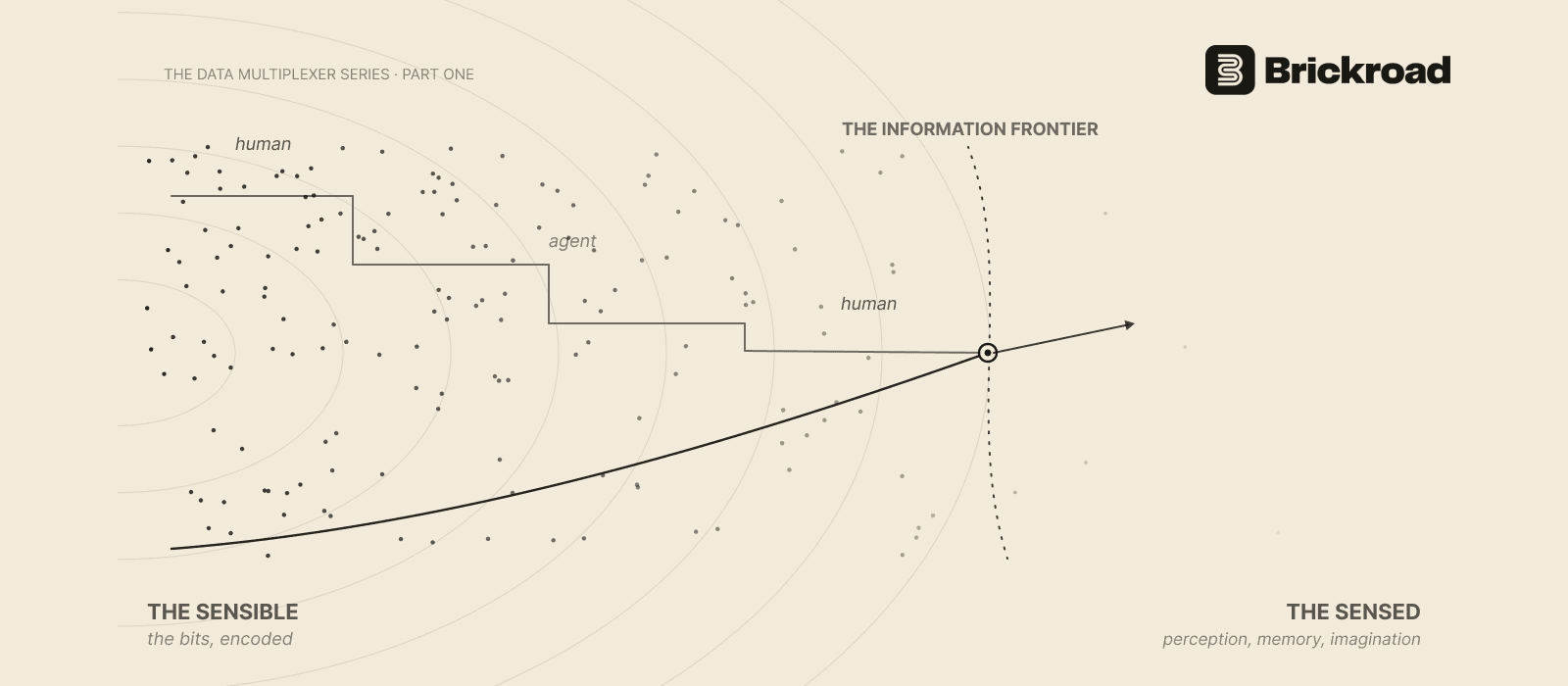
This is the first installment in a three-part series on agentic data provisioning. Part 1 lays the theoretical foundation: why the most valuable data lives at the boundary of what has been observed, and why reaching it requires not just automation but cognition. Part 2 goes inside the architecture of programmatic provisioning. Part 3 maps the future of data composability, valuation, and liquidity.
Interested in exploring the Information Frontier? Brickroad's Information Frontier Agent is live today.
If James Bond were a data sourcing agent, in early April 2026, he'd have been adventuring on the Omani coast in sweatpants and a snapback in search of the latest alpha, a trading advantage, at the information frontier of the Strait of Hormuz. On a modern millennial data sourcing mission, Citrini's Analyst #3 recounted a harrowing tale of smuggling a gimbal, microphone kit, and a pair of recording sunglasses past an Omani border inspection, surviving a midnight visit from the Omani CID at his hotel, and venturing out to the coast of Iran, dodging IRGC patrols and one-way suicide drones, all to observe and count the number of ghost ships, vessels running dark with their transponders off, traveling through the strait, invisible to the AIS tracking used by traders around the world.
He did it because he thought that the AIS tracking systems weren't capturing reality on the ground, and the only way to close that gap was to go see it himself. The data he needed didn't exist on the internet or any terminal. It existed only at the frontier. And as every analyst, bank, and hedge fund tracked the Strait from inside the sensed universe of AIS feeds, stale satellite imagery, and recycled Pentagon briefings, Analyst #3 came back with information that existed nowhere else but for those at the frontier, and built a thesis around that reality unlike any other firm's. A thesis that proved out the very next day, when ceasefire terms confirmed exactly what he'd found on the water: Iran wasn't closing the strait, it was running a toll booth.
For most firms, of course, the frontier is nowhere near as cinematic as the Strait of Hormuz. It is a deeply buried corporate silo: the unindexed ERP database of a mid-tier regional distributor, the usage logs of a vertical SaaS platform, a decade of route data sitting inside a logistics operator that has never once thought of itself as a data company. These are ghost ships too, running dark in the digital supply chain, invisible not because someone hid them but because no one has gone to look. The strait is a vivid instance of a general fact: the most valuable data almost always sits just past the edge of what anyone has bothered to encode, and reaching it takes the same faculties Analyst #3 carried to the water.
Nevertheless, it is worth pausing on what, exactly, Citrini and Analyst #3 brought to that coastline, because it is illustrative of our later point: it was not just money and equipment. It was a spark of insight, an understanding of the regional culture, and the local knowledge to read what the feeds could not. Intellect, wisdom, cognition, however you want to call it (arguably they are different), that is what it took to reach the frontier, and it is the subject of this piece: can agents replicate intellect in a way that is economically valuable?
Here is why it matters, and our thesis. The information frontier will never stop producing new information, alpha, like that found at the Strait of Hormuz. As energy systems and compute expand, increasingly it will be the case that to access the best information, that at the frontier, we will require tools beyond human capabilities. That is because the information plane is expanding faster than any human can cover. In fact, the information gap is widening, not closing, despite and because of AI, and every increment of energy and compute that should let us catch up only expands it faster.
Thus we need tools, almost certainly agents, to reach that ever-growing corpus. But agents in their current form will fail to reach the frontier unless they are paired with something most of this generation of agents sorely lack: intellect, of the kind Analyst #3 carried to the water.
That is the whole of our argument. Agent use is essential to economic success, particularly in areas dependent on information at the frontier, where the pace of expansion far surpasses human capabilities. But agents on their own have real and specific shortcomings, while humans retain real and specific virtues, of intellect and of judgment, that no model has yet replaced. Meaningful economic progress at the frontier will not come from agents replacing people, nor from people refusing agents. It will come from the two working in deliberate collaboration, each supplying exactly what the other cannot.
The frontier itself is not in question; it always exists, and always will. What remains to be worked out is how humans and agents reach it together.
A Sample of the Universe
In 1937, Edwin Hubble delivered the Rhodes Memorial Lectures at Oxford under the title The Observational Approach to Cosmology. Standing at the boundary of everything then known, he drew a hard line between the universe and what he could actually see of it, stating at the outset that "[t]he observable region of space, the region that can be explored with existing instruments, is a sample of the universe." The universe was whatever was actually out there. The observable region was what the 100-inch reflector on Mount Wilson could reach; about a thousand million light-years in any direction, populated by roughly a hundred million nebulae.
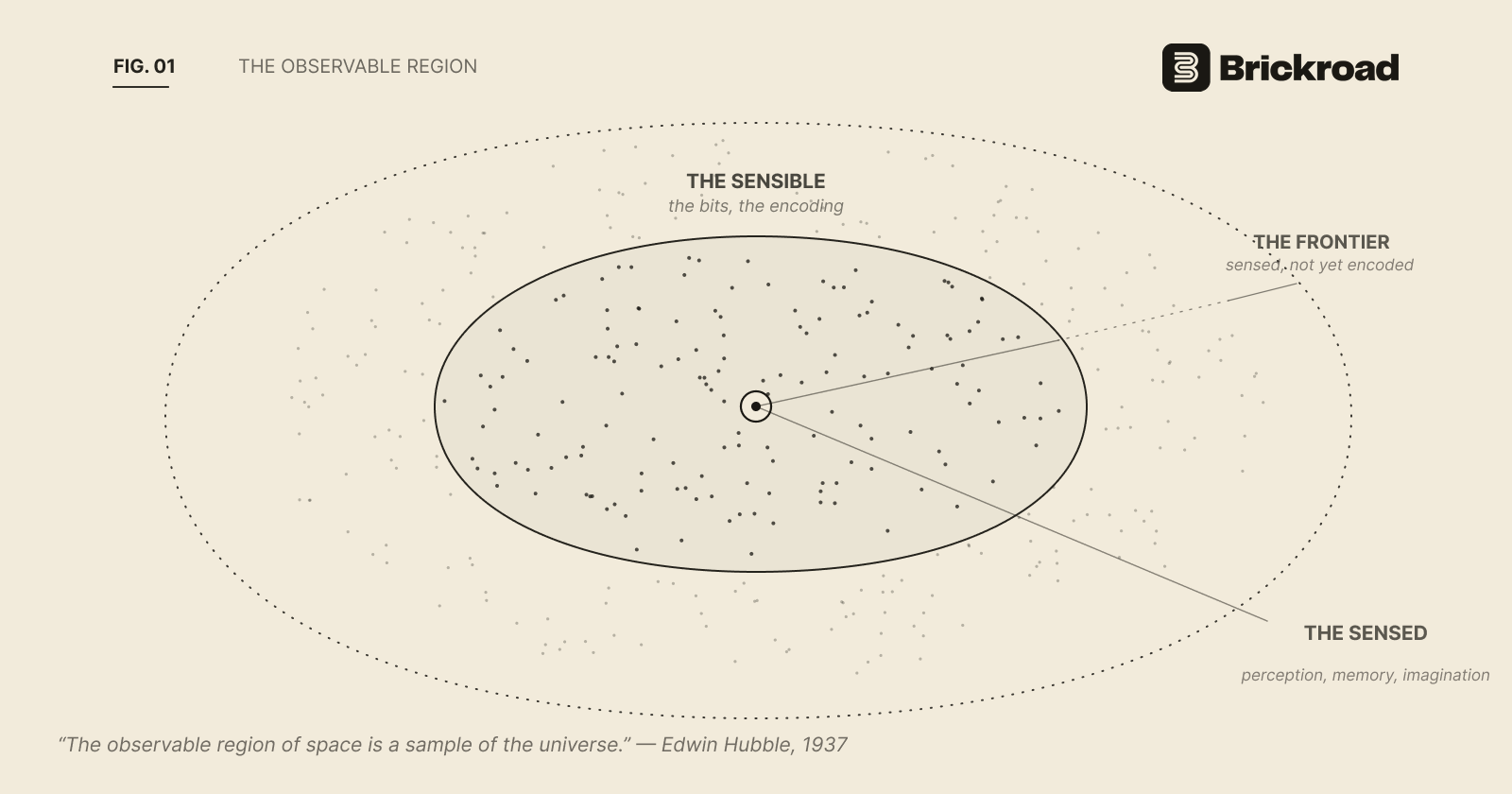
Nearly a century later, Stephen Wolfram formalized a version of this insight as observer theory. Any observer, a human, a sensor, a fund, takes the raw complexity of the world and compresses it into a reduced representation that a finite mind can act on. When zillions of photons strike the eye, we extract an arrangement of objects. When billions of molecules strike a piston, the machine reacts to that pressure. The observer equivalences, treating vast numbers of distinct configurations as the same thing, because its computation is tiny next to the computation going on in the world around it. And in fact, the computation is constrained. As Joseph Wong noted in his recent work on observer-dependent universes, observation costs time and energy, and that cost, and the ability to offset it, sets the rate at which any observer can update its picture of the world. Observers that integrate information at different frequencies literally inhabit different resolutions of the same system.
Translate that to data markets. The universe, for our purposes, is everything that can in principle be sensed: a ship moving through a strait, a tariff reshaping which trades clear, a factory switching suppliers, a court filing signaling a regulatory shift. These things happen whether or not anyone records them. Information is the computable form of the sensed, a timestamp, a schema, a row in a table; the moment a phenomenon is encoded it crosses from the sensed into the sensible, where it can flow, be priced, and be modeled. The frontier is the gap between the two: between what exists in the world and what any feed, model, or index has actually captured. It can be temporal, the lag between a ship going dark and anyone encoding that fact; it can be economic, phenomena that are sensible but too expensive to sense at current margins; or it can be simply a coverage gap, where no one has thought to look: the regional logistics firm sitting on a decade of route data that no analyst ever framed as a tradeable signal.
Critically, the gap is not closing. In a forthcoming paper recently submitted to NeurIPS (a draft of which is available here), my Brickroad colleague and co-founder Luis Oala showed that at the rate the world currently senses and encodes, on the order of 10²⁰ bits per second across every camera, sensor, and instrument combined, a complete scan of the Earth alone would take something like 10²⁴ years. The sensed is permanently chasing the sensible, exactly as each improvement of Hubble's telescope revealed not convergence but more universe. The frontier is not an artifact of immature tooling; it is a structural feature of the system, and while better instruments widen our reach into it, we will never truly close it. The sensed universe is always chasing the sensible one, and the sensible one never holds still.
Just as Hubble's story was about instruments, with each generation of telescope pushing the observable region of the cosmos outward, ours is about agents and artificial intelligence, and their ability to push to the boundaries of the world's information.
Speed Is Not Intellect or Intelligence
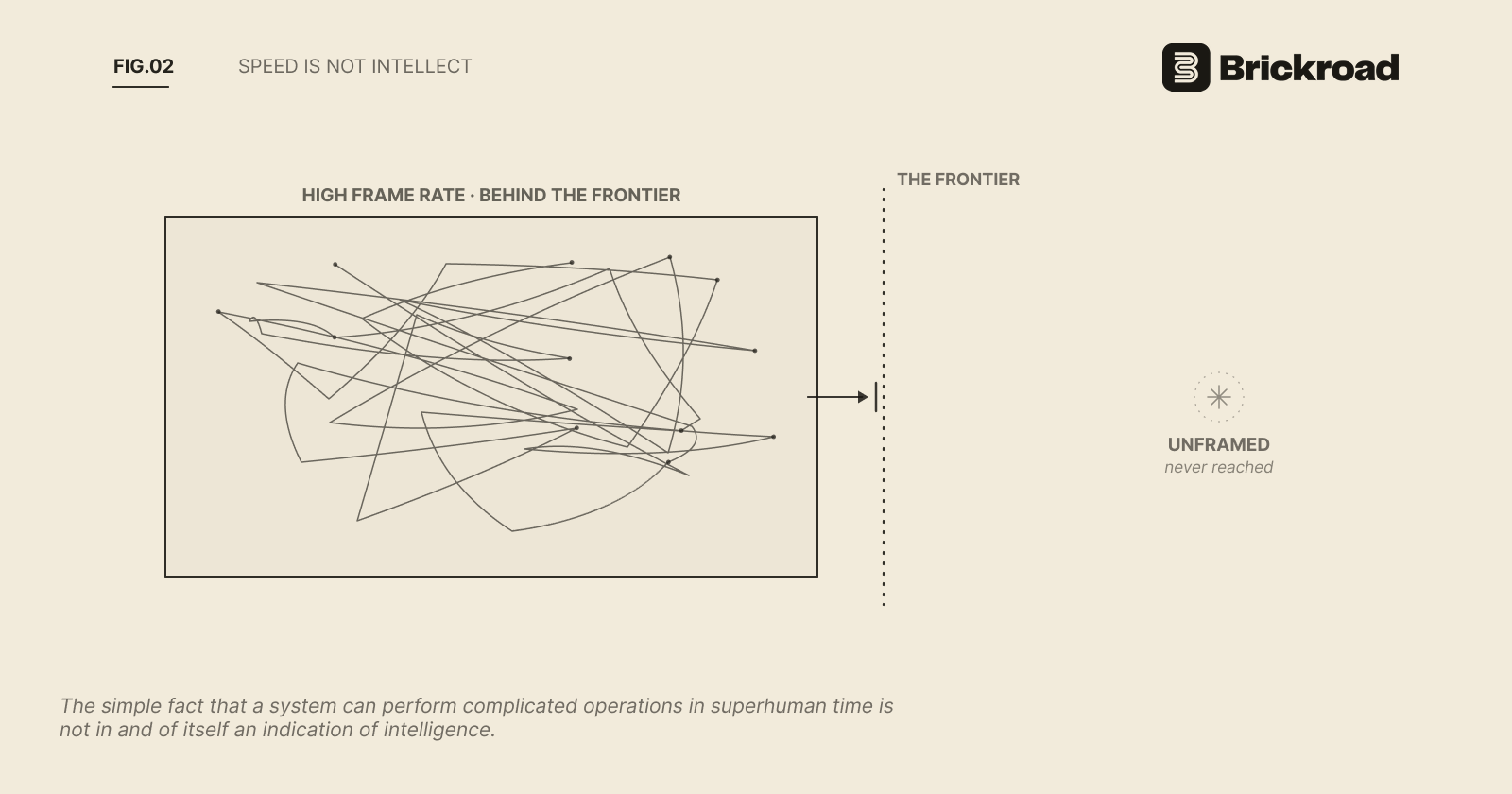
One way to think about an agent is as an autonomous software system that can reason, search, evaluate, and act at a higher frame rate than a human data strategist. Where she refreshes her picture of the market quarterly, or when a conference reminds her to look, the agent refreshes continuously. Where she pattern-matches across the suppliers her network already contains, the agent traverses the open and closed web, regulatory filings, the appendices of academic papers, the metadata of platforms that don't think of themselves as data companies.
As tempting as it is to stop there, it belies the deeper story of the intellect that Analyst #3 and many experienced data strategists possess.
Just as a faster crawler is still a crawler, an agent that traverses every marketplace catalog, every vendor list, and every conference agenda at machine speed is doing the same thing the human analyst did, just quicker. Speed applied behind the frontier does not move you to the frontier; it simply compresses the interval between publication and entropy. If the entire advantage of AI and agents is solving complications at a higher velocity than humans, they will do little to expand our observable universe. The point is not that agents lack value; we will argue they are essential. It is that raw velocity is not the sole faculty the frontier rewards.
The skeptics of machine intelligence understood this long before the current agent wave. In 1980, John Searle published what has come to be known as the Chinese Room argument: a person who speaks no Chinese sits in a room with an instruction manual, receives Chinese symbols through one window, and passes back correct responses through another. The room produces fluent output. It understands nothing. Searle's point was that syntax is not semantics, that manipulating symbols at any speed and scale is not the same as grasping what they mean. Notice what the argument does not say. It does not say the room is slow. The room could run at any frame rate you like and the objection would hold with full force. Speed was never the issue.
A more recent statement of the case, Víctor Velarde-Mayol's Artificial Intelligence and Human Intellect, sharpens the point with a classic experiment in animal cognition. A chimpanzee learns to put out a flame blocking its food by fetching water from a tank in a bucket. When we move the whole setup onto rafts in the middle of a lake and empty the tank, the animal is stranded: it never thinks to dip the bucket over the side, because it never grasped what water is. It learned a procedure, not a nature. Like today's agents, its trained loop runs flawlessly until the world steps outside the training, at which point the thing that looked intelligent turns out to be an instrument run by its own past. Velarde-Mayol's point is that abstraction, the grasp of the common nature beneath the particulars, is what makes a creative response to a novel problem possible, and that no amount of mechanical polish substitutes for it.
Similarly, most (but not all) of the agentic or LLM-based data market tooling is effectively chimpanzees with buckets. Point a retrieval-shaped agent at "datasets" and it returns things labeled datasets; it will not reliably look at a regional logistics firm and infer that a decade of route-optimization exhaust is a tradeable signal, because nothing in the firm's presentation says data. To be clear, this is not the case for all agents — Brickroad's Information Frontier Agent, for example, is specifically designed to perform this kind of cross-domain abstraction in the course of its discovery operations. Rather, the claim is that most off-the-shelf agents fail in this frontier task, where, by definition, nothing is yet labeled. In our research, the vast majority of agentic systems lack the ability to reliably perform the kind of unprompted recognition that an enterprise-grade tool, one a desk can rely on, demands.
Even the optimists concede that deficit. Dilip Jeste and colleagues, surveying the field from inside clinical AI research, argued in 2020 that intelligence, the thing our systems are best at, the processing speed and pattern recognition, is not the quality that makes systems valuable to the people who depend on them. What is missing, they wrote, is closer to wisdom: learning from experience and self-correcting, exercising judgment, and acting well under conditions no training run anticipated. Their term for the goal was artificial wisdom. Ours is intellect.
The Anatomy of Intellect
Whether an agent can instantiate the structure of intellect depends on your definition of the same. Jewish philosophy, as memorialized in textual form during the late Enlightenment, is instructive in that regard.
In 1796, Rabbi Schneur Zalman of Liadi published the Tanya, the foundational text of Chabad philosophy. The name Chabad is itself an acronym for a theory of mind: Chochmah, Binah, Daat. Wisdom, understanding, knowledge. The Tanya lays out these three faculties not as synonyms for "being smart" but as distinct, sequential operations, each with its own function, each necessary, and none sufficient alone.
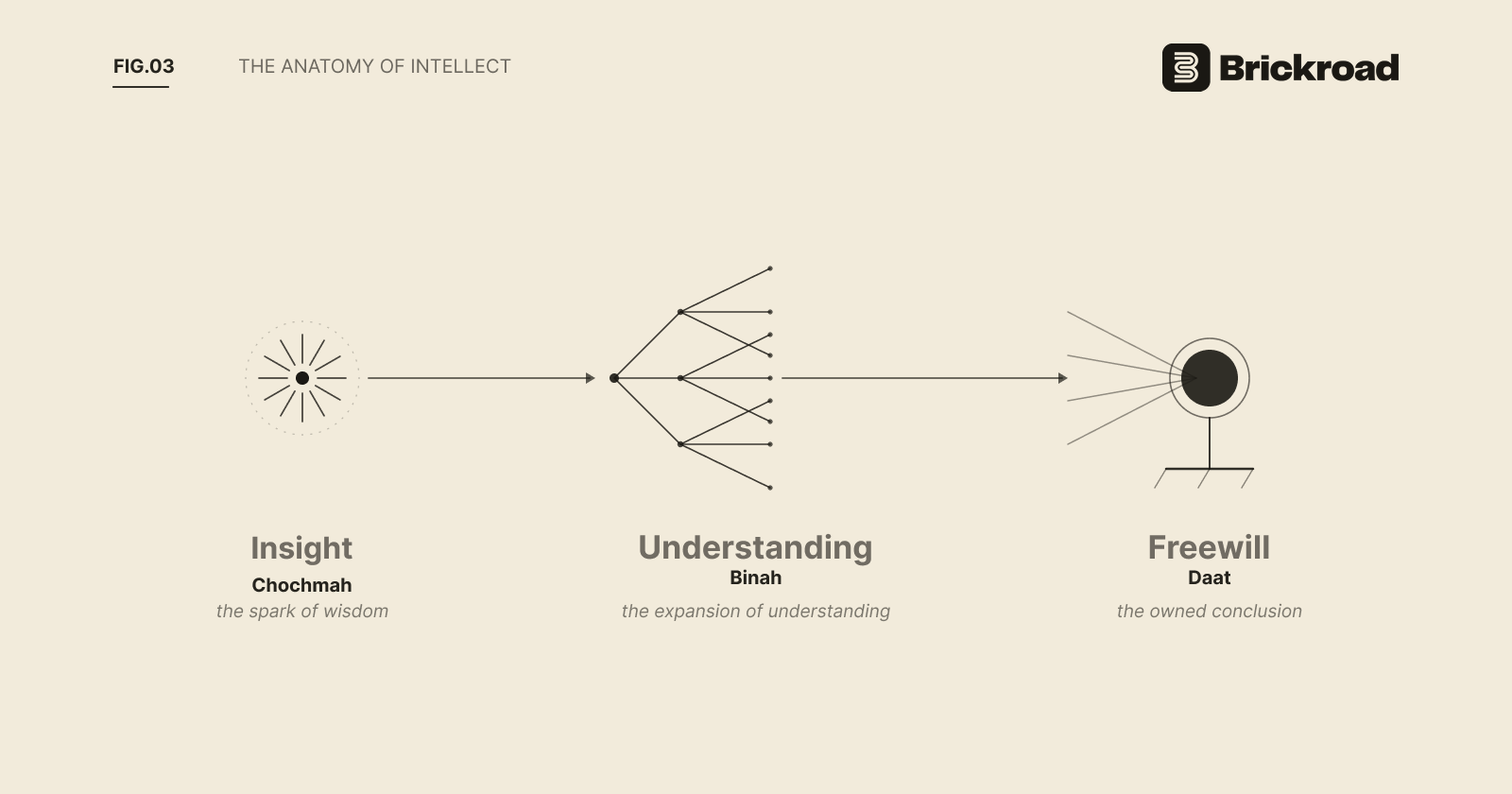
Chochmah is the flash, the bolt of lightning: the first, compressed point of an idea, arriving whole but unarticulated. The etymology is telling; chochmah can be read as "koach-mah," the power of "what?", the capacity to be struck by a question the rest of the world has not thought to ask. It is the analyst looking at an AIS feed and sensing, before he can defend it, that the absence of ships in the data is itself the signal. It is the moment a researcher realizes that a regional logistics firm's route records are not operational exhaust but a tradeable time series. Chochmah does not retrieve. It notices.
Binah is the build-out, understanding one thing from within another, inference: taking the compressed point and unfolding it into structure, with length and breadth, details and ramifications, until the flash becomes an argument that can survive contact with evidence. If Chochmah is the seed, Binah is the cultivation. In the data sourcing context, Binah is everything that happens after the hunch: the schema inferred, the coverage estimated, the provenance traced, the claim checked against the source.
And then Daat, usually translated as "knowledge," though the Tanya is explicit that it is not the accumulation of information. Daat is independence: the free will by which a person makes a conclusion on their own and commits to it, under uncertainty, as a decision she authors rather than one handed to her. It is the freedom to have chosen otherwise and to choose anyway; to be the genuine origin of the commitment rather than a relay for it. A person can be brilliant in Chochmah and exhaustive in Binah, yet if no independent self steps forward to own the conclusion and its consequences, the output is effectively intellectual slop, or what the Tanya calls vain fancies.
Intellect, in this framing, is not any one of these faculties but the arc that runs through all three: the flash, the unfolding, and the independent self that owns the conclusion. Watch what happens when a data strategist is missing one element. Without Chochmah, the analyst is diligent but blind; she may run flawless evaluations, but only on the sources someone else thought to put in front of her. Without Daat, she may be brilliant but inert, authoring a glowing opinion that commits her to nothing. Strip either end, and while you may have sped up a data strategist's workflow, you have similarly removed the value of the output.
Cognitive scientists support this framing. In 1973, William Chase and Herbert Simon published Perception in Chess, demonstrating that a grandmaster's apparently magical first-glance judgment is built from tens of thousands of stored patterns, "chunks," accumulated over years of structured exposure. Simon later compressed the finding into a sentence that could have been a gloss on the Tanya: "The situation has provided a cue; this cue has given the expert access to information stored in memory, and the information provides the answer. Intuition is nothing more and nothing less than recognition."
Gary Klein found the same structure in fireground commanders, who in his studies almost never compared options at all; a pattern fired, a workable course of action surfaced, and they moved. When Klein and the late, storied psychologist Daniel Kahneman wrote their 2009 joint paper Conditions for Intuitive Expertise, they agreed on the boundary conditions of trustworthy intuition: the flash is reliable only in environments with learnable regularities, and only for observers who have had the exposure to learn them. Chochmah, in other words, is not mysticism. It is recognition operating over a sufficiently deep store of structured experience, surfacing a compressed conclusion before the reasoning that justifies it.
Kahneman and Klein's paper went further. The flash, on its own, they wrote, is dangerous. Intuition is "sometimes marvelous and sometimes flawed," and the expert's subjective confidence is no guide to which. What separates usable intuition from expensive delusion is the discipline that follows it: the deliberate, analytical unfolding that tests the flash against the world. Laymen call this verification, or analysis. The Tanya called it Binah.
Finally, independence, the faculty most often confused with mere decisiveness. Yes, machines decide — at enormous scale. Systematic strategies run a majority of daily US equity volume, by many estimates, somewhere between 60 and 75 percent, much of it executing with no human approving any single trade. But executing a strategy is not the same act as willing it. The machine runs the policy it was given; it does not originate the choice to pursue this thesis over that one, to accept this risk, to stake the book on an unproven source. That originating choice, made freely under uncertainty by an agent who could have chosen otherwise, is Daat, and it remains the fundamental fact of human intelligence. No increase in a model's capability will change that, because the limit is not one of capability but of kind. An AI system is stochastic: its every output is a function of its programming, algorithm, and its training data.
Neither Alone
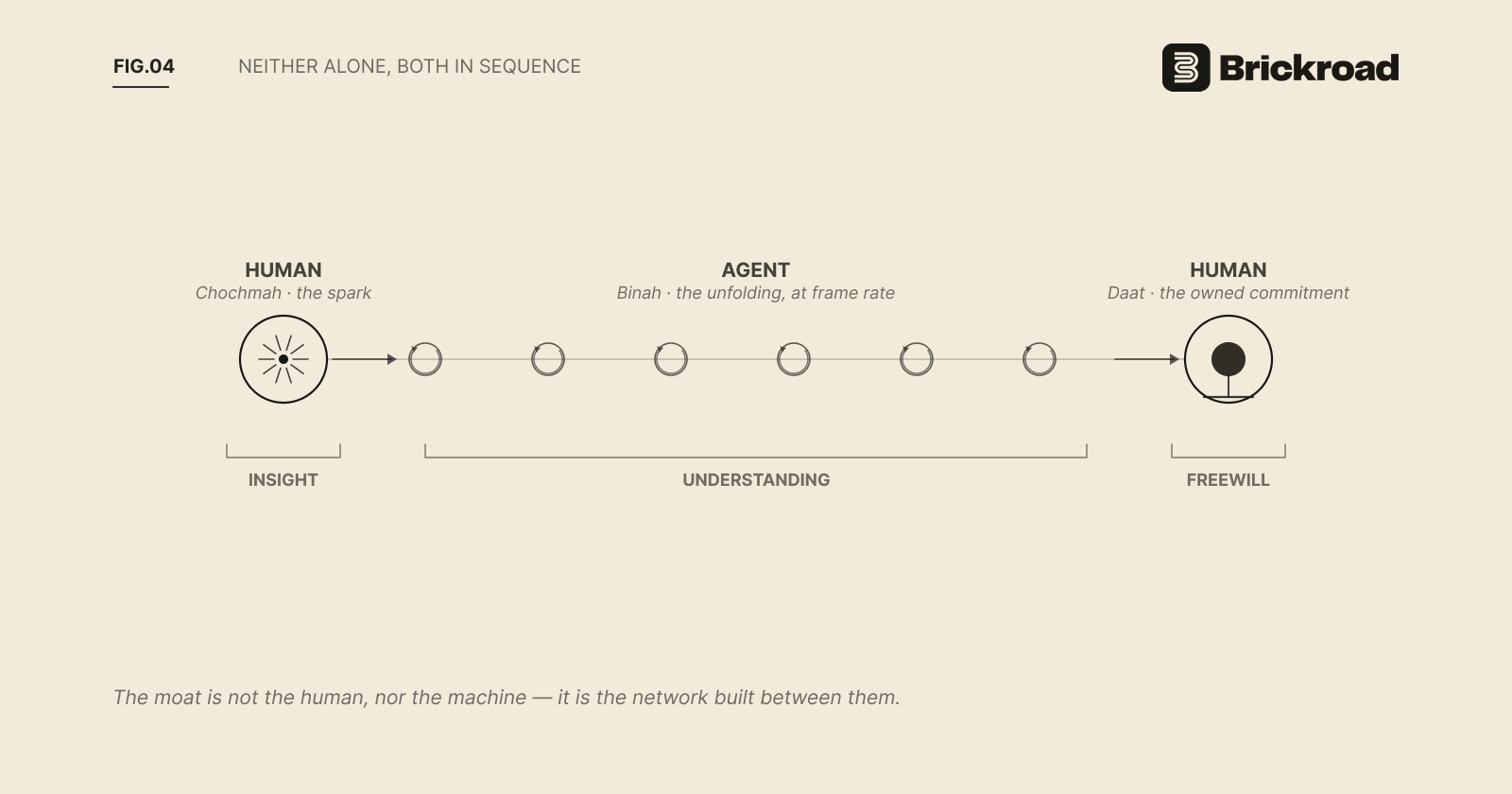
If agents are a necessary tool for closing the ever-widening alpha gap at the information frontier by virtue of their ability to observe at a higher frame rate than any human, where does that leave us, the humans?
In a stronger position than this article might initially suggest. Agents have proven themselves masters of the middle faculty, Binah, but what they continue to fall short on are the two faculties that bracket it, which remain the humans. The Chochmah spark, noticing a signal before the world has framed it, is something models are improving at but cannot yet be relied on to do unprompted at the frontier, so for now we must keep a human in that loop. The Daat, the freewill to author a commitment under uncertainty and stand as its source, is not a capability gap at all; it is structural and endemic to how AI works: a machine executes the choices it is given; it does not make them on its own.
With this framing, those who wish to outperform the market should consider the marriage of human capital with agents — rather than shying away from the latter. As Microsoft's CEO Satya Nadella argued recently on X, the human capital and token capital are not mutually exclusive. To the contrary, when used together, they appreciate in value.
In fact, done well, this partnership becomes a vital moat. Those who run agents against the rote middle, letting them run at their naturally high framerate, constrained only by energy and compute, at the edge of the sensible universe, the information frontier, free the data strategist to spend her scarce hours where they actually compound, steeped in the conversations and signals of the sensed universe. Mr. Nadella appropriately calls the result a hill-climbing machine.
The moat is not the human, and it is not the machine; it is the network built between them. The frontier is reachable by neither alone: not by the strategist, whose spark and judgment are exactly right but whose coverage is bounded by the twenty-four hours in her day, and not by the agent, which has the tireless reach but neither the spark to find the unframed source nor the freewill to make the close its own. It is reached, and only reached, by the two together, the human supplying the ends, the agent carrying the middle. Neither alone; both, in sequence.
A Better Telescope, A Working Mind
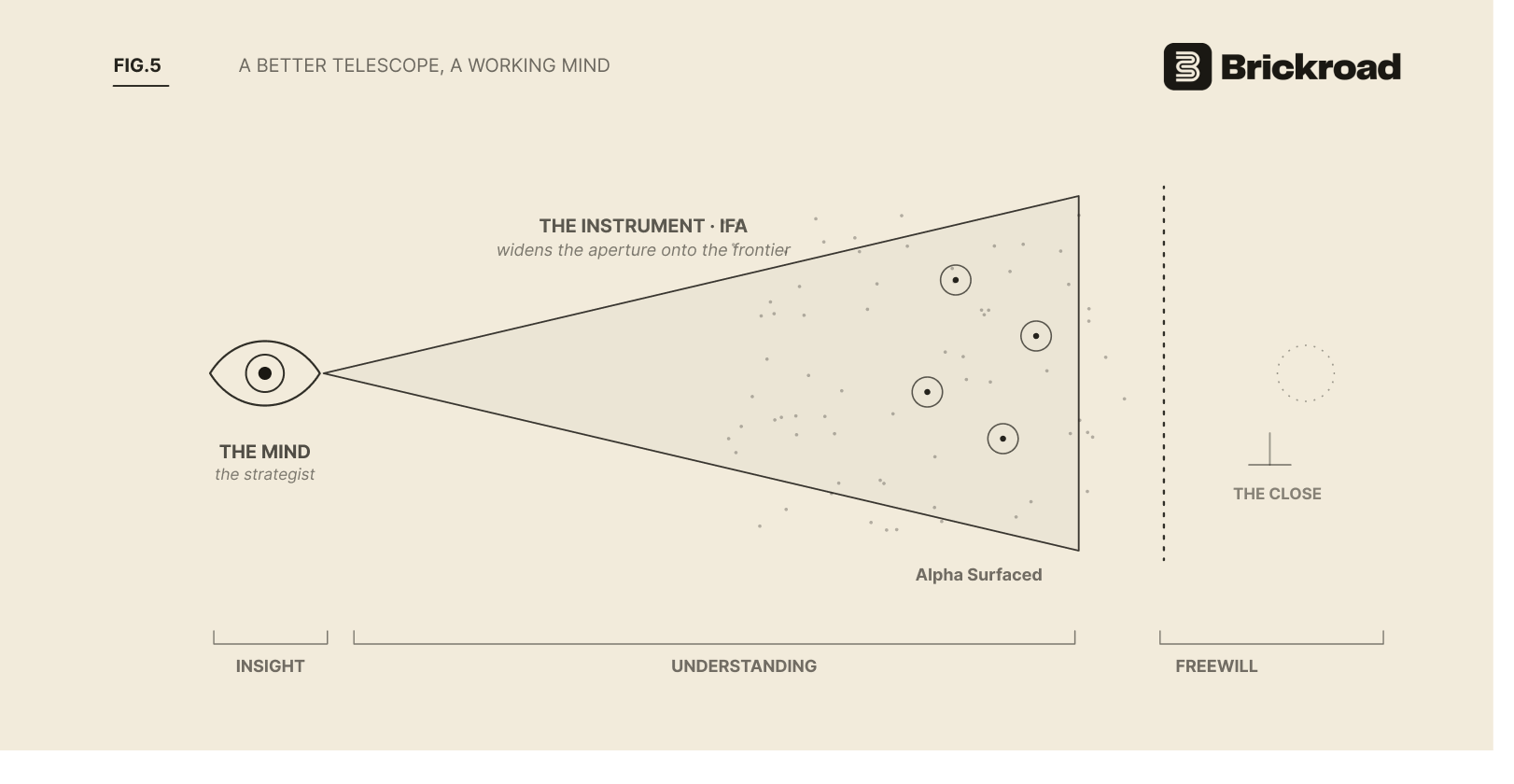
Hubble closed his Oxford lectures with a choice: "[o]nce again, as in the days of Copernicus, we seem to face a choice between a finite, small-scale universe and a universe indefinitely large plus a new principle of nature." The data market faces a version of the same choice. There are those who will continue to treat the sensed universe, the feeds, the marketplaces, the indexes, as the whole of what's available, and compete in a region where every signal is already priced. But others will, and already have, accept that the frontier is real, that it is structural, that it expands faster than any human team can chase it, and that the instrument they point at it determines what they can know.
Brickroad built that instrument. As a frontier lab building agentic infrastructure for data provisioning, our Information Frontier Agent (the "IFA") is the first of several solutions purpose-built for human-agent data sourcing. Its job is not to think for the strategist; it is to do the Binah of the middle at a scale she cannot, and to do one specific thing ordinary tooling cannot. A Bloomberg terminal and a data catalog can only return what has already been listed. The IFA is built for the opposite: it is tuned, through scoring signals like absence from known catalogs, non-traditional provider status, and gaps in coverage across search engines, to surface the suppliers and assets that sit at the frontier between the sensed and the sensible, the off-catalog operator with data it never thought to sell. As a result, it can process over two thousand sources in seconds, and point to those candidates that a data directory, search engine, or LLM would never surface. The IFA widens the strategist's aperture into what's available at the frontier, surfacing the unframed so a human can recognize what matters, and then it stops, deliberately, before the procurement decision, because the decision is hers to own. It is an instrument for the information frontier in the way the telescope was Hubble's for the cosmos: it extends reach; it does not replace the mind doing the looking.
The lessons of Hormuz, Hubble, and the Tanya serve as a reminder that the telescope itself was never the thing that reached the frontier. The mind behind it was. Thus, we are building ours to be wielded, not to wield: an instrument for the strategist whose spark finds the source and whose judgment closes on it. A better telescope, and a working mind to point it. Together. That is the intellect the frontier demands, and the intellect we are building, Brick by Brick.
This is Part 1. In Part 2, we'll go inside the architecture of programmatic provisioning: how agents source datasets along the frontier, how the multiplexer handles the cold-start problem of discovering assets that have never been described, and how the system learns from every sourcing cycle to expand its own observable region. Part 3 pulls it all together to map the future of data composability, valuation, and liquidity.